
What do you need for a First or a 2:1?
Enter your marks and how your university weights each year. You'll see your average so far and the average you need on the rest for a First, 2:1, 2:2 or Third.
§ 01Your degreeWorked out on this device
Your degree, so far.
Weighted by credits within each year, then by each year's share of your degree. Leave anything blank that isn't marked yet.
How your years count
Rules differ by university and even by course. Your handbook or the university's assessment regulations say how your years are weighted; these are common splits, not any one university's rules.
Your marks
§ 02One moduleExams, essays, coursework
What do I need on the rest of this module?
The same as above, for one module. List its assessments and what each is worth, fill in the marks you’ve had back and leave the rest blank. You’ll see the average you need on everything still to come, exam included.
Weightings are each assessment’s share of the module, as your module page lists them. Leave a mark blank if it isn’t back yet.
§ 03RitualEvery module, automatically
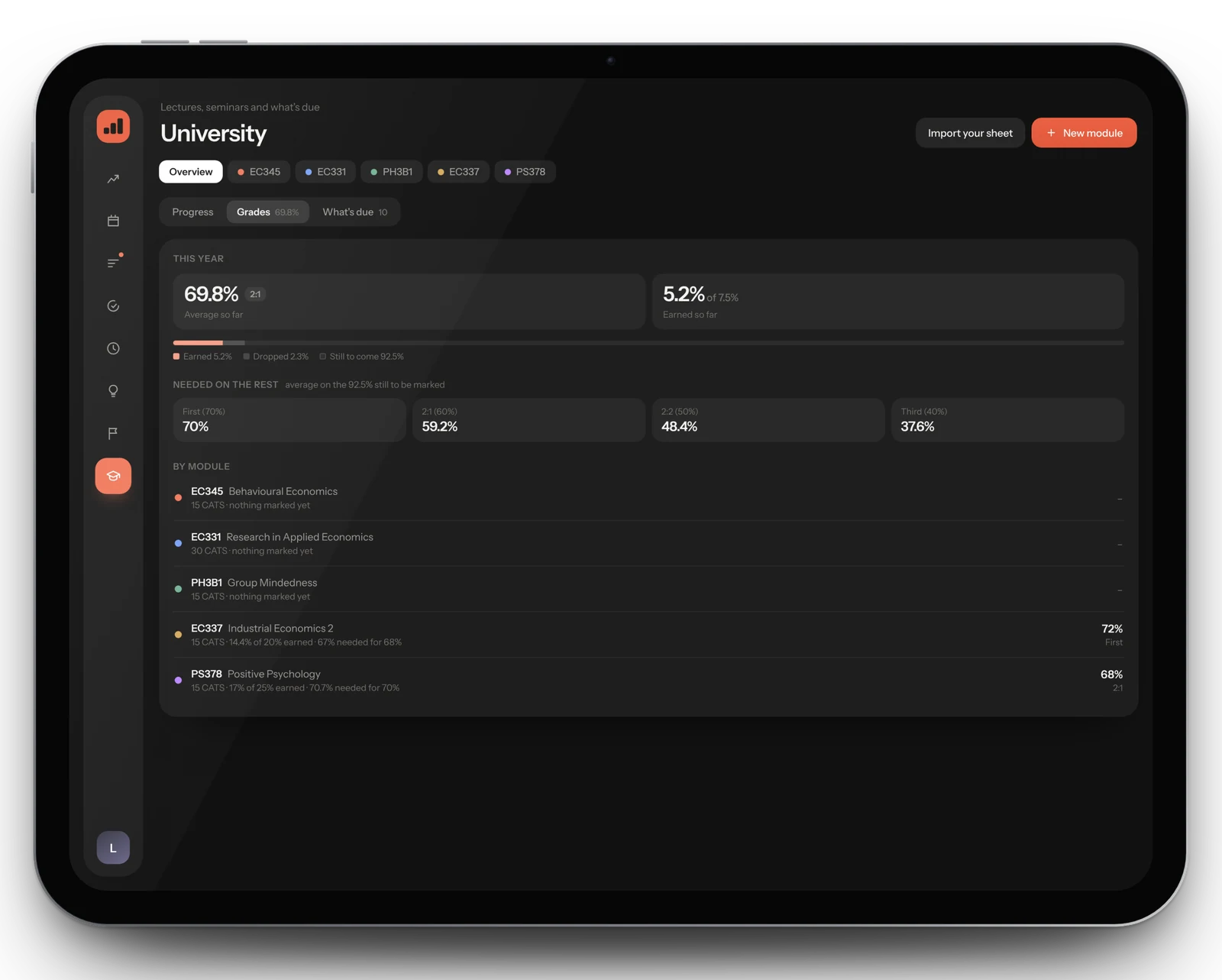
Ritual does this for every module, automatically.
Add your modules once and Ritual works out your average and what you need on the rest as each mark comes back. It also tracks your deadlines and habits. Join the waitlist.
- Your grade so far and what you need, by module and for the year
- Every lecture, seminar and deadline on your calendar, in its module's colour
- Habits, tasks and a daily share price to keep you going
§ 04ExplainedThe sums behind it
How UK degree classifications are calculated.
The classes
An honours degree is classified by your overall average. The usual bands are:
| Class | Average | Also called |
|---|---|---|
| First | 70 and above | First-class honours |
| 2:1 | 60 to 69 | Upper second |
| 2:2 | 50 to 59 | Lower second |
| Third | 40 to 49 | Third-class honours |
Credits, then years
Within a year, each module counts by its credits (often called CATS points). A full-time year is usually 120 credits, so a 30-credit module counts twice as much as a 15-credit one.
Then each year counts for its weighting. At many universities the first year of a three-year degree doesn't count, and the second and final years are split somewhere between 50/50 and 20/80, with the final year counting more. Some count only the final year, and four-year degrees, placement years and integrated master's have their own rules.
Borderlines and other rules
Most universities have extra rules for marks close to a boundary, often within one or two marks. Some round to the nearest whole number; some look at where most of your credits sit (sometimes called preponderance); some discount your lowest-scoring credits or take the better of two methods. Rules differ, so check your university's regulations. This calculator shows the straight weighted average and doesn't round up.
Worked example: one module
Your coursework is worth 40% of the module and you got 62. The exam is the other 60%.
Banked: 0.4 × 62 = 24.8
For a 2:1: (60 − 24.8) ÷ 0.6 = 58.7%
For a First: (70 − 24.8) ÷ 0.6 = 75.3%
So you need 58.7% in the exam for a 2:1 on the module, and 75.3% for a First.
Worked example: the degree
Your second year counts for 40% and averaged 62. Your final year counts for 60%: two 30-credit modules are back at 68 and 62, and 60 credits (a module and the dissertation) are still to come.
Final year so far: (30 × 68 + 30 × 62) ÷ 60 = 65 on half the year
Banked: 0.4 × 62 + 0.6 × 0.5 × 65 = 44.3 of 70 marked
Average so far: 44.3 ÷ 70 = 63.3%
For a 2:1: (60 − 44.3) ÷ 30 = 52.3% on the rest
For a First: (70 − 44.3) ÷ 30 = 85.7% on the rest
Those are the example marks the calculator opens with.
§ 05Questions6 answered
Degree classifications, answered.
01What percentage is a First, a 2:1, a 2:2 and a Third?
At most UK universities a First is an overall mark of 70% or more, an upper second (2:1) is 60 to 69, a lower second (2:2) is 50 to 59 and a Third is 40 to 49. Below 40 is usually a fail, though some universities award an ordinary or pass degree instead. These bands are the usual ones for a bachelor's degree with honours, but your university's regulations are what count.
02Does first year count towards my degree?
At many UK universities the first year of a three-year degree doesn't count towards your classification, but you need to pass it to carry on. Some courses do count it, usually for a small share. Check your course handbook, and if yours counts, choose Custom in the calculator and give the first year its weighting.
03How do I work out what I need in my exam?
Multiply each marked piece of work by its weighting and add them up: that's what you've banked. Subtract it from the mark you want, then divide by the exam's weighting. With coursework worth 40% marked at 62, you've banked 24.8 of the module's 100. For 60 overall you need (60 − 24.8) ÷ 0.6 = 58.7% in the exam, and for 70 you need (70 − 24.8) ÷ 0.6 = 75.3%.
04Is 69.5% a First?
It depends on your university. Some round the final average to the nearest whole number, so 69.5 becomes 70. Many also look again at anyone within a mark or two of a boundary, using rules such as having most of their credits in the higher class. The calculator doesn't round up: it shows your average to one decimal place and flags when you're within two marks of the next class.
05What are CATS points or credits?
Credits, often called CATS points, show how big a module is. A full-time year is usually 120 credits, split into modules of, say, 15 or 30. A 30-credit module counts twice as much towards your year average as a 15-credit one.
06Can Ritual work this out for me as my marks come in?
Yes. Ritual's University page holds your modules, deadlines and grades, and works out your average so far and what you need on the rest, for every module and for the year, using the same sums as this calculator. Ritual is in beta, and the waitlist hears first when places open.