
I've put it in the order I use it: the one test that sits above everything else, how to research before you write, what each of the three paragraphs is for, the words to cut, the six ways a letter usually goes wrong and the checklist I run before I send one.
- Every fact needs a purpose. If you can't say in one sentence why a fact, figure or project is there, cut it.
- Research before you write. Find one deal you can have a view on, or the less obvious figure in a firm's own report, and say what it means.
- Paragraph one is about the firm. Start from something that's yours, then turn onto their work. No more than a third of it should be about you.
- Paragraph two is about the role: what its features would let you learn, with research in a supporting sentence.
- Paragraph three is about you: a framing sentence, then numbers for scale, speed, outcome and who saw your work.
- Write plainly. Cut the careers-page phrases and the clever lines, and check it couldn't be sent to a competitor with the name changed.
01The rule above everything else
Every fact, figure, project or detail you include must have a purpose. Ask yourself why it's there. If you can't answer that in one sentence, cut it.
A statistic about a firm's revenue tells the firm something it already knows. The only reason to include it is that it supports a point you're making about why you want to work there, why the role interests you or why your experience is relevant.
This applies in three directions:
- Facts about the firm must back an argument. They aren't there to prove you visited the website.
- Figures from your own experience must establish scale, pace, level or outcome.
- Projects and interests must connect to something specific about the firm or the role. They aren't there to show you're well-rounded.
The failure is fact-dropping: a correct, well-sourced and entirely pointless sentence. The recruiter reads it, thinks "yes, that's our revenue" and moves on. Nothing has been communicated about you.
02First, check the letter is read at all
Read the posting and the firm's FAQ before you write anything. One consultancy's London page says Associate Consultant applicants "will not need to submit a cover letter" (Bain & Company). Other firms require one, and some swap it for short written answers. Read what's actually asked.
If a letter is optional, write one only when you have something specific to say. Otherwise put the hours into the written answers or test practice.
03Format and layout
There are two accepted layouts.
Full formal. Your home address, then the company's address block (department, legal entity, street, city and postcode), then the date, "Dear Recruitment Manager,", the body and "Yours faithfully,".
Streamlined. This suits most applications now. Your name, phone and email on separate lines, no address blocks, the full date written out, then a line reading "Re: Application for [exact job title], [Firm]", then "Dear Hiring Committee,", three paragraphs, a closing line, your sign-off and your name.
Rules for both:
- The greeting and sign-off must agree. A named person goes with "Yours sincerely". "Dear Sir/Madam", "Dear Recruitment Manager" or "Dear Hiring Committee" goes with "Yours faithfully". Oxford's careers service gives the same pairing (University of Oxford). Plain "Sincerely" is the American form; plenty of international firms use it, but the British pairing is the safe choice in the UK.
- Use the exact job title from the posting.
- Verify the company address if you include one. Companies House and regulatory filings give the legal entity and registered office. Don't guess.
- Length: 400 to 600 words on one page, with the body text justified. Part-time and hospitality applications are the exception, where a longer and warmer letter works better.
- File name: "Firstname Lastname, Job Role, Cover Letter", saved as a PDF. Recruiters see the file name before they open the file, so check its spelling as carefully as the letter's.
UK careers advice agrees on length. Prospects suggests "three to five concise paragraphs" that "should not exceed one A4 page" (Prospects), and TargetJobs says one side of A4 when no word count is given (TargetJobs).
04Research before you write a word
If you open a template before you have any material, the writing gets pulled toward structure with nothing to put in it. Do the research first. You need one of two things.
Option A: a deal, mandate or transaction
For advisory, banking, private equity and most client-facing finance roles, a specific deal is usually the better choice. It's more concrete than a statistic, more interesting to read and far more likely to lead somewhere in an interview.
A transaction gives you something to have a view about: what made it complicated, who the competing interests were, why the structure took the shape it did and what the adviser was actually being paid to solve. None of that comes from a revenue figure. It also shows a different kind of research. Anyone can open a results release. Reading about a transaction, understanding the parties and working out what was difficult takes effort, and the effort shows.
How to choose one. Pick the deal you can say something real about, which is rarely the largest one on the firm's deals page. Good reasons to pick a transaction:
- it sits in a sector you've worked in or followed;
- it involved a structure or problem you've met at a smaller scale;
- it's the kind of situation you want to learn, and you can say why;
- it complicates something you assumed about how deals of that type work;
- it shows the firm doing something its competitors don't.
What to say about it. Name the deal, then say in one or two sentences what made it difficult or distinctive. Keep the interest analytical. "An impressive mandate" says nothing. Say something about the problem itself: reconciling founders and investors with different time horizons, a sponsor underwriting a growth plan rather than a cost plan, or a carve-out where the hard part was separating the business, with the valuation the easier half.
What to avoid. Don't list three transactions. Don't state the deal value as if the number is the point. Don't name a deal you can't discuss further, because naming it invites the question.
Option B: a published report, insight or set of results
This suits research, markets, payments, consulting and product roles, and it's the right choice when the firm doesn't publish its mandates.
Take the second-best fact. Everyone quotes the biggest number. The figure underneath is more revealing and less crowded. If a firm reports record revenue, the number of individual fees above a threshold may tell you whether growth came from a broad client base or from one or two large mandates.
The interpretation is the point. A number alone communicates nothing. What you read into it does.
Rules for both
- It must be relevant to the desk as well as the firm. A piece on European equity market structure is interesting, but in a payments application it signals that you read something on their website, which isn't the same as reading about your job.
- Only use what you can defend. Results releases, annual reports, named executive guidance and announced transactions are safe. If something can't be traced, leave it out. Hedging it doesn't help.
- Know which statements are your own inferences. Drawing a conclusion the source doesn't state is fine, and often impressive, but know that it's yours before the interview.
- Check what the firm actually publishes before you promise yourself material. Some publish very little. If there's nothing suitable, use a structural or commercial fact (how the firm is owned, how it makes money) and don't pad.
05Paragraph one: why the firm
Start from something that's yours, then turn onto the firm
The paragraph should begin from your own angle: a story, an interest, a project or something you already know. That starting point then leads straight into something you found in your research.
This is what separates genuine interest from researched interest. Anyone can find a fact. Only you can explain why that fact caught your attention, given who you are and what you've already done.
The personal part is the way in, though, and it shouldn't take over. Once you've said where your interest comes from, the paragraph belongs to the firm. It's the place to show that you understand what the firm does and why it's good at it. Showing yourself off can wait.
A useful proportion is one sentence on your angle, then the rest of the paragraph on the firm: what they did, what was difficult about it, what their structure or ownership allows them to do and what their approach makes possible. Your experience earns you the right to an opinion about their work. It isn't the subject.
The one-third testRead the paragraph back and count the sentences about you against the sentences about them. If more than a third are about you, rewrite it. Paragraph three is where you make your case. Paragraph one is where you show you've understood theirs.
The three shapes
Continuation. The firm's work continues something you already do or care about. You've built, studied or worked on something, and the firm operates at the next level of it.
Contradiction. The firm's approach cuts against something you thought you knew. You formed a view, their work challenges it and you want to understand why. It's the most intellectually credible shape and the rarest in applications, so it's worth looking for.
A new perspective, or a new stage of the process. You've seen one part of a process and the firm occupies another. Having worked on the sell side, you want to understand how the buyer underwrote the same business. This is the shape I've used most, because my placement gave me a ready-made gap: I saw deals through to completion on the sell side, and much less of how the buyer judged the business or what happened after the deal.
You don't need an M&A placement for any of this. "I ran the society's budget, but I never saw how the money was raised" is the same move.
In practice
Weak, a fact with a compliment attached"I was impressed by the firm's role advising on one of the largest transactions announced in the sector last year, which demonstrates its position as a leading adviser."
Also weak, because it never leaves the applicant"My placement taught me how founder-owned businesses are sold, which developed my understanding of deal dynamics and gave me the analytical grounding I would bring to your team."
Strong, the opening two lines of paragraph one"My placement was spent on sell-side processes for founder-owned businesses, which is why the firm's role on [deal] stands out. The adviser had to reconcile a founder, several investors on different timelines and a sponsor underwriting a growth plan, and did it as an independent firm with no financing to sell alongside the advice."
One line says where the interest comes from. The next is entirely about the firm: who was at the table, what made the brief hard, and what being independent meant. From there, the rest of the paragraph stays on the firm, which is how you pass the one-third test.
Rules for paragraph one
- Never lift the firm's promotional phrasing. "Global leader", "industry-leading", "world-class", "trusted adviser", "serving clients in more than one hundred countries". Their marketing team wrote that copy.
- Make one connected argument. Three admirable features with a sentence each reads like a scorecard.
- Build on commercially real ground: how the firm makes money, what its ownership allows and what its spending says about its priorities.
- Avoid fact-then-meaning. "The firm's results show growth. This indicates a strong pipeline." It's generic and speculative.
- Don't overclaim what a statistic proves. Growth doesn't guarantee a pipeline.
- Don't start selling yourself. No skills, no qualities and no "I would bring". Save them for paragraph three.
TargetJobs makes the same point about generic praise. It warns against lines like "you are a dynamic, international, leading business", which "could apply to most of the large banks and firms in the UK" (TargetJobs).
06Paragraph two: why the role
This paragraph explains why you want this particular role and programme, as distinct from the company, and shows that your interest rests on something concrete.
1. Lead with the role, before any statistic. Give your reason for being interested first. Any research you bring in afterwards then has a clear purpose.
"The programme particularly appeals to me because it combines structured training with early exposure to live transactions."
2. Explain why the programme's features matter to you.
Weak"The programme offers rotations, technical training, mentoring and exposure to senior colleagues."
Stronger: say what those features would let you learn. Rotating across teams might let you see how the parts of a business fit together before you specialise. Early work on live transactions might appeal because you learn fastest when you hold responsibility and get feedback on real output. Small deal teams might matter because they put an analyst close to people who've done the work for decades. Describe the opportunity through what you'd gain, rather than listing what the employer provides.
3. Use research to support the reasoning. If a firm's report shows investors becoming more selective, use it to explain why rigorous underwriting matters and why you want to learn it there. Ask whether a reader would understand why you included it. If they wouldn't, make the connection natural or cut it. The report gets roughly one sentence. If it fills the paragraph, the paragraph is about the report.
4. Integrate facts into the argument. Avoid stating a fact and then explaining it in the next sentence. What you found interesting, how it relates to the role and why it strengthens your interest should arrive together.
5. One central argument. Develop two or three strong reasons properly. Don't sweep in culture, global reach, progression, technology and benefits.
6. Don't repeat the other paragraphs. The first is why this firm. The second is why this role, and why now. The third is why you're suited to it.
7. Keep it proportionate. Cut anything that sounds like a careers page: "the ideal platform to develop my expertise", "the unique opportunity to leverage my skills", "this aligns perfectly with my career aspirations".
The shape: what appeals about the role, then what you'd gain from its specific features, then the research that reinforces it, then why that makes this the right opportunity now.
A test from Prospects that I run on every draft: "remove the employer's name from the document and read it through to judge whether you could use the same letter when applying for a similar role at another company" (Prospects). If paragraphs one and two still work with another firm's name in them, they aren't finished.
07Paragraph three: why you
This is where you show that your experience has prepared you, and it's the one paragraph that should be about you throughout. The challenge is to make your suitability obvious without it reading like competencies copied from the posting.
1. Open with a short framing sentence, then go straight into the evidence. "I screened over 200 companies across five sectors" is a strong fact and a weak opening line, because the reader has no frame for it yet. Open with one plain sentence that names what the role demands, in the job description's own terms, so the evidence lands against something:
"My experience has prepared me for the pace and commercial focus of the Associate role."
"My placement has given me the analytical grounding the Analyst position requires."
Keep it to one line. It's a hinge between the paragraphs, and it shouldn't try to be a thesis. What it must not become is the generic version: "My experience has developed my analytical, communication and problem-solving skills." That names skills instead of framing the role.
2. Use numbers wherever you have them. This is the core of the paragraph. Numbers turn a claim into a measurement, and a recruiter can assess a measurement. Four types carry weight:
| Type | What it shows | Examples |
|---|---|---|
| Volume and scale | How much you handled | 200 companies screened, 15 mandates, 30 comparables per mandate, 5 sectors, 5 students tutored |
| Speed and deadline | Pace, which most graduate applicants can't evidence at all | 48 hours per mandate, same-week outreach, three years of cost data analysed |
| Outcome and result | What happened because of your work. These are the strongest | 10 successful pitches, cost efficiency improved by about 15%, project timelines cut by about 10%, £1,200 of revenue in a first month |
| Seniority and audience | The level you worked at | Shortlists delivered directly to the Head of Origination, work reviewed by Partners and Directors, material used in live client pitches |
Where you have no number, say why the work was significant instead. Was it on a live transaction or a practice exercise? Did it feed a decision? Did it go to a client? "Supporting financial and tax due diligence on a live transaction" is measurable in a way that "gaining an understanding of due diligence" isn't.
3. Connect the experience through the work itself. Make the connection, but don't explain it every time.
Avoid"This developed my ability to manage competing priorities, which is essential for a Consultant managing multiple client workstreams."
Prefer"Moving between five sectors and several mandates meant forming a view on unfamiliar businesses quickly, deciding which information mattered and keeping the analysis accurate under tight deadlines."
For consulting, that conveys structured thinking, prioritisation and accuracy. For an investment role, the same experience could be framed around commercial judgement. The experience stays the same; you change the part you emphasise.
4. Match the underlying requirement. Work out what the person in the role will actually need to do well, rather than pulling out keywords. If the role involves diligence, use the time you examined financial information and found discrepancies. If it involves client contact, use the time you explained a proposition, handled an objection or adapted to someone else's priorities. The link should be clear to anyone who understands the role, even though you never write "transferable skills".
5. Include only the details that strengthen the argument. A cover letter isn't a second CV. You don't need every mandate, platform and responsibility. Choose the numbers that matter for this role and leave the rest on the CV.
6. Make your experiences complement each other. The paragraph doesn't have to rest entirely on professional experience, and a second example makes the application more distinctive if it adds something new. A placement might establish analysis under pressure. An online business could show how you think about pricing, customers and commercial decisions, with its own numbers attached. Building a product could show that you test ideas and refine them against feedback. Give each example a purpose. Don't add a side project just to claim another skill, and don't force every example onto a different competency.
7. Keep the connection subtle, but not invisible. Describe the experience in detail, then make one natural connection where it adds something:
"I also built [product] and took it to [the customers it was for]. Speaking to them directly forced me to test my assumptions about the market, explain the product's value and respond to objections."
That's evidence of commercial thinking and client communication, without the predictable claim that it "developed my communication and entrepreneurial skills".
8. End by bringing the evidence together. The last sentence should leave a clear sense of what you'd bring. Link your technical background, qualification or degree to the work itself. A modelling qualification might support your ability to analyse investment opportunities. A degree combining economics and psychology might support an interest in incentives and decision-making. Keep the claim proportionate. You're showing a foundation, and nobody expects you to have mastered the job.
The logic: a framing sentence, then what you did with the numbers attached, then what the work involved, then why it matters in this role. If every sentence ends by naming a skill, the connection is too explicit. The aim is evidence strong enough that you don't have to keep explaining it.
Length and order: roughly 140 to 180 words. The framing sentence, then your most role-relevant experience, then one other example chosen for a specific demand of the job, then your degree or qualification tied to something the role involves.
TargetJobs' advice on applying to McKinsey says the best letters "explain not only why you want to work for that firm, but also why they want you to work for them" (TargetJobs). Paragraphs one and two say what you want to learn. Paragraph three is where you pay that back.
08The close
One line, thanking them and offering to discuss it further:
"Thank you for considering my application. I would welcome the opportunity to discuss my experience and interest in [Firm] further."
Avoid "these experiences have equipped me with the skills required to succeed in this role". If you want a final clause, end on something specific. And don't leave the close out: it's two lines, and a letter that stops dead after the last piece of evidence reads as unfinished.
09Voice, and what to cut
The target sits between two failures. One is narrative or poetic writing: observations dressed up as insight, "what stayed with me was", or framing one thing as a grander version of another. The other is writing stripped back to basic English. Overcorrecting produces something that reads as simple rather than clear.
What works is plain, direct sentences with reasonably sophisticated vocabulary. When a draft reads too plainly, upgrade the words where they sit and keep the sentences and structure. Don't add ornament.
Cut:
- aphorisms and "not X but Y" constructions;
- clever contrasts, especially any that put down other applicants;
- colon-reveal sentences, where the point is held back and then delivered;
- a lesson drawn after every item;
- lists of three by default (if two things are enough, use two);
- mechanical transitions such as "Moreover", "Furthermore", "Ultimately", "Taken together" and "In turn";
- filler phrases: "I am particularly drawn to", "I am excited by", "this resonates with me", "intellectually stimulating", "dynamic", "fast-paced", "unique opportunity", "well-positioned" and "strong foundation";
- em dashes.
Prefer varied sentence length, ordinary connectives, the active voice and evidence that implies a quality instead of naming it.
10Six ways a letter goes wrong
Each of these is a real draft of mine that I rejected and rewrote. Most advice describes the target. It's more useful to know the ways of missing it.
- Too polished. Every sentence carries an insight, a contrast and a conclusion. The giveaway is that no sentence simply says something and moves on.
- Too plain. Overcorrecting into short statements and basic vocabulary. It's accurate, modest and forgettable.
- Too narrative. Storytelling where the letter needs statements.
- Too listy. "On deal X I did Y, which is where I learned Z", four times over.
- Too promotional. Marketing language lifted from the firm's own materials.
- Too self-regarding (paragraph one only). The applicant uses the firm as a prompt to talk about themselves, and the reader learns nothing about why this firm and not another.
The target sits between all of them: plain structures, precise words, statements rather than stories, points grouped rather than listed, your words rather than theirs, and the firm as the subject wherever the firm is the subject.
11Honesty
- Never overstate your involvement. "Took two deals through to completion" becomes "joined two processes at their later stages and contributed to diligence". If your CV and letter describe the same work differently, the more careful document exposes the other.
- Don't invent contact with the firm. If you've been to a presentation, a spring week or a careers fair, or spoken to someone there, put it in. It's one of the strongest things a letter can contain.
- Don't claim an interest you can't evidence. Rather than asserting a passion for financial technology, point at what you built.
- Keep claims proportionate to your stage. You're applying to learn.
- Numbers must be real. Rounded is fine ("around 15%"). Invented isn't. Every figure in your letter is a question you've invited.
- Anything in the letter should be on your CV. An interviewer reads both, and a project that appears only in the letter is the first thing they'll ask about.
12One CV, different letters
One CV supports very different letters. The evidence doesn't change; the order and framing do.
| Role type | Lead with |
|---|---|
| Generalist programme | Breadth: screening across several sectors |
| Operations or settlement | Reconciliation, accuracy and completion mechanics |
| Payments or technology | Things you've built |
| Consulting | Structuring data on unfamiliar industries and forming a view quickly |
| Client-facing or phone-based | Sales calls, outreach and handling objections |
| Markets | Trading, data work and systems |
13The template
Your name
Phone
Email
Full date, e.g. Wednesday 7 October 2026
Re: Application for exact job title, as advertised, Firm
Dear named person if the posting gives one; otherwise Hiring Committee,
Paragraph 1, why the firm. One sentence on your own angle: what you did, studied or built, and where it stopped. Then the rest on the firm: the deal or the less obvious figure you found, what made it difficult or distinctive, and what the firm's structure or approach makes possible. No more than a third about you.
Paragraph 2, why the role. What appeals about the role, then what you'd gain from two or three of its specific features, then one sentence of research that reinforces the reasoning, then why now.
Paragraph 3, why you, 140 to 180 words. A framing sentence in the job description's terms. Your most relevant experience with its numbers: scale, speed, outcome, audience. One other example chosen for a specific demand of the job. Your degree or qualification tied to something the role involves.
Thank you for considering my application. I would welcome the opportunity to discuss my experience and interest in Firm further.
Yours sincerely, for a named person; Yours faithfully, otherwise
Your name
14The checklist before you send
- Could this be sent to a competitor with the name changed? If so, rewrite paragraphs one and two.
- Does every fact, figure and project have a purpose you can state in one sentence?
- Does the "why the firm" paragraph start from something that's yours, then turn onto the firm?
- In that paragraph, count the sentences about you against the sentences about them. More than a third about you means a rewrite.
- Does the "why you" paragraph open with a framing sentence rather than a cold statistic?
- Have you used every relevant number you have? For anything without a number, have you said why it was significant?
- Is every claim about you backed up by your CV?
- Is any sentence there for style rather than doing work?
- Is the firm's report confined to about one sentence?
- Is every figure verified, with a source you could give if asked in an interview?
- Does it fit on one page?
- Is the firm's name right everywhere, including in any paragraph you reused? Do the role title and the team match the posting?
- Have you checked the spelling, the grammar and the gaps between sentences? It's the easiest screen to fail.
- Is the file named "Firstname Lastname, Job Role, Cover Letter" and saved as a PDF?
Then get someone else to read it. TargetJobs recommends a friend, a family member or your careers service (TargetJobs).
15The process
- Research before drafting, always.
- Expect to rewrite the voice more than the content. Most of my rewrites changed how things were said, with what was said staying the same. Nobody warned me about that.
- Give specific feedback, whether it's to a friend, a careers adviser or yourself. "This whole thing is wrong" produces another guess. "This sentence is too clever" produces a fix.
- Keep a standing checklist, so each letter starts at your standard instead of working back up to it. The list above is mine.
16How Ritual helps
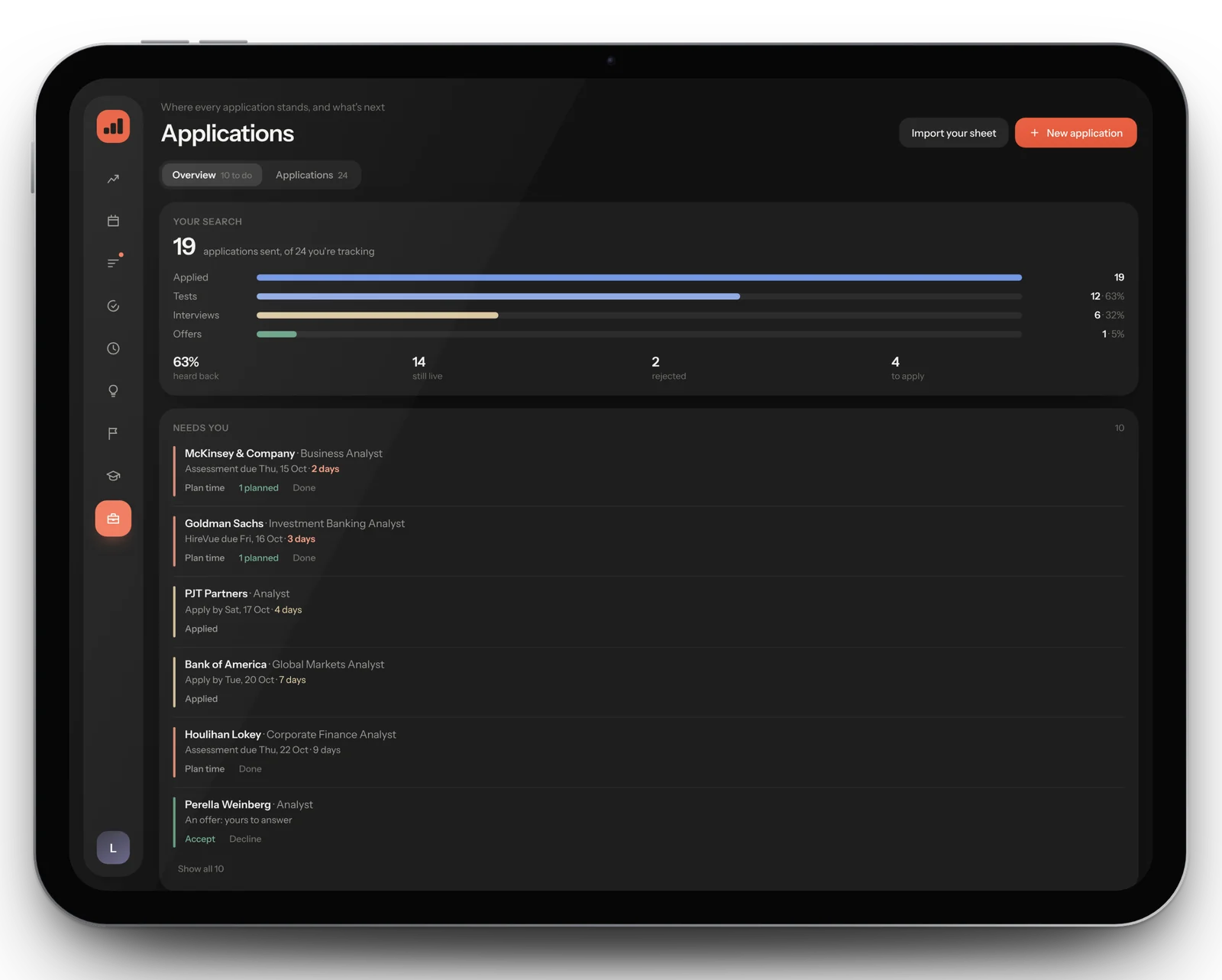
Ritual's Applications page keeps every application in one place, so you always know which letter went where and what happened next. Bring in the spreadsheet you already use (Excel, CSV or a Google Sheet link) and it reads your own status wording, so "Submitted – HireVue to complete" lands as a test to do.
- Deadlines and test due dates on your calendar
- A "needs you" list: tests to finish, deadlines coming up and applications that have gone quiet for three weeks
- Searchable notes on each application, for which version of your letter went there
- A pipeline of how many reached a test, an interview or an offer
Ritual is in beta. Join the waitlist and you'll hear first when places open.
17Questions, answered
01How long should a cover letter be for a graduate finance or consulting role?
Between 400 and 600 words, on one page, unless the firm gives a word count. If it does, stick to it, and that goes for written answers too.
02Should I mention a specific deal in my cover letter?
For advisory, banking and private equity roles, usually yes. Choose one you can discuss in an interview, say what made it difficult and leave the deal value out unless it's the point. For consulting, markets, research and product roles, or when a firm doesn't publish its mandates, a less obvious finding from its own research usually works better.
03What should each paragraph of a cover letter cover?
The first is why this firm: one sentence on your own angle, then the firm's work. The second is why this role and why now: what its features would let you learn. The third is why you: a framing sentence, then your evidence with numbers, then your degree or qualification tied to the role. Then a one-line thank-you close.
04Can I reuse one cover letter for several firms?
Reuse your evidence and rewrite your argument. Paragraph three changes by a sentence or two between firms, depending on what the role needs. Paragraphs one and two should be rewritten every time: if they'd still work with a competitor's name in them, they aren't finished.
05Who should I address a cover letter to, and how do I sign off?
A named person if the posting gives one, signed off "Yours sincerely". Otherwise "Dear Hiring Committee" or "Dear Recruitment Manager", signed off "Yours faithfully". Don't guess a name from LinkedIn.
06Can I use AI to write my cover letter?
Check the firm's rules first. Bain's London page asks applicants to "only use AI, such as Chat GPT or Claude, to check grammar and spelling in your CV", and doesn't allow it in the assessment or interviews. Either way, a letter that follows this method needs your research, your experience and your view, and nothing else can supply those.
18Sources
All accessed 22 October 2026. Requirements change every recruiting cycle, so check the live posting.
- Prospects, "How to write a cover letter"
- TargetJobs, "How to write a cover letter for an investment banking role"
- TargetJobs, applying to McKinsey: CVs, cover letters and interviews
- Bain & Company, London recruiting
- University of Oxford Careers Service, cover letters
Something here out of date, or a question the guide doesn't answer? Email hello@getritual.app. More in Guides.