
- Your class usually comes from a credit-weighted average of the years that count, against bands of 70 (First), 60 (2:1), 50 (2:2) and 40 (Third).
- Each university sets its own algorithm: which years count and how much, how it rounds, and what happens just below a boundary.
- First year often counts for nothing (Bristol, Leeds, Swansea), but not everywhere: at LSE it's 2 of the 18 marks that decide your class.
- Sector guidance caps the borderline zone at two points below a boundary. Inside it, some universities upgrade you automatically, some apply a rule about your mark profile, and some leave it to the exam board.
- So the same marks can be a First at one university and a 2:1 at another. The worked example below shows one.
- Your regulations are the answer. Search for your university's degree classification rules, and read the version for the year you started.
01The classes, and how many get each
An honours degree is classified by a single overall mark. The bands almost every UK university uses are below, alongside the share of graduates who got each class in 2024/25.
| Class | Overall mark | Share of graduates, 2024/25 |
|---|---|---|
| First | 70 and above | 30% |
| Upper second (2:1) | 60 to 69 | 49% |
| Lower second (2:2) | 50 to 59 | 19% |
| Third | 40 to 49 | 3% |
The bands are the sector's convention, set out in Universities UK and GuildHE's guidance on degree algorithms [1] and in individual regulations such as Warwick's [6] and LSE's [16]. Below 40, some universities award an unclassified pass degree: at Warwick, an average from 35.0 to 39.9 [6]. The shares are HESA's figures as reported by Prospects [4]; Warwick's degree outcomes statement gives the sector's 2023/24 split as 29% Firsts and 48% 2:1s [5]. Firsts have roughly doubled since 2010-11: in England they went from 15.8% then to 28.8% in 2023-24 [3].
02Step one: module marks, weighted by credits
Every module carries credits, often called CATS points (from the Credit Accumulation and Transfer Scheme). One credit stands for about 10 hours of learning, a full-time year is usually 120 credits, and a three-year honours degree is 360 [8] [7] [4]. Within a year, a 30-credit module counts twice as much as a 15-credit one.
A module mark is itself a weighted average of its assessments: coursework at 40% and an exam at 60%, say. One small detail matters more than it looks. Some universities round each module mark to a whole number before averaging them (Nottingham does [9]), and the sector guidance says rounding should ideally happen only once, on the final mark [1].
03Step two: which years count, and how much
The sector guidance describes four common ways to weight a three-year degree [1]:
| Approach | Year 1 / 2 / 3 |
|---|---|
| Final year only | 0 / 0 / 100 |
| Emphasis on the final year | 0 / 33 / 67 |
| Equal | 0 / 50 / 50 |
| First year included | 10 / 30 / 60 |
Real rulebooks vary within and beyond those shapes:
| University | What counts towards your class |
|---|---|
| Bristol | Not first year. Years two and three, weighted by programme; a year away usually counts 10% [10] |
| Leeds | Years two and three, weighted 1:2 [11] |
| Swansea | Everything above first-year level, in bands that give your best 80 final-year credits the most weight [15] |
| UWE Bristol | All final-year credits and your best 100 second-year credits, the final year counting three times as much (if you started from August 2022) [13] |
| Edinburgh | Years three and four of a four-year degree; only the final year if you spend year three abroad [12] |
| LSE | Second and third years, plus your first-year average as 2 of 18 classification marks [16] |
So, does first year count? At most of these, no: you have to pass it to carry on, but its marks stay out of the average. At LSE, and on any course using the 10/30/60 shape, it does. Your course handbook or programme specification will say which.
Then the sum itself. Say your second year averaged 67.5 and your final year 69.2, weighted 1:2:
(67.5 + 2 × 69.2) ÷ 3 = 68.6
That's a 2:1 on the bands, 1.4 below a First. Whether it stays one is the subject of the next two sections. The free degree classification calculator does this sum for any weighting, and shows the average you need on the rest for each class.
04Step three: rounding, or is 69.5 a First?
The guidance calls rounding within 0.5 on the final mark "fair, arithmetically appropriate, and easy for students to understand" [1]. Most universities do something like it, but not all:
| University | 69.5 is | Why |
|---|---|---|
| Leeds | A First | Averages within 0.5 of the next boundary get the higher class [11] |
| UWE Bristol | A First | 69.5 to 69.9 is raised automatically [13] |
| Bristol | A First | The final mark is rounded to the nearest whole number [10] |
| Warwick (2020/21 starters) | Borderline | Kept to one decimal place, so it's a 2:1 the exam board must reconsider [6] |
05Step four: the borderline zone
Since 2020 the sector guidance has recommended "a maximum zone of consideration of two percentage points from the grade boundary, with no additional rounding": a 68 can be looked at for a First, a 67.99 can't [1]. A QAA report the same year found that 85% of institutions had a borderline policy [2]. Inside the zone, there are three kinds of rule. All of them decide whether you go up a class.
Automatic
Close enough is enough. Leeds and UWE Bristol give the higher class within 0.5 [11] [13], which works like rounding.
A rule about your mark profile
You go up if enough of your marks are already in the higher class, often called preponderance, or if your final year is, often called exit velocity:
- Nottingham: only a rounded 69, 59 or 49 is borderline. You must get the higher class if two-thirds of your final-year credits, or of your last two years' credits, are in it [9].
- Bristol: within two marks, you get the higher class if 50% or more of your marks, weighted by credits and year, are in it [10].
- Swansea: within 2%, the board should raise you if half or more of your counting credits are in the higher band, or your final-year average is [15].
- Surrey (from 22 April 2026): within two points, you go up if your final-year credit-weighted average reaches the higher class [14].
The exam board's judgement
Under Warwick's convention for students who started in 2020/21, a mean within 2.0 of a boundary must be reconsidered, and the board may weigh your final-year performance, a preponderance of module marks above the boundary and your core modules [6]. Warwick's newer Rules for Award, for students who started from 2021/22, moved to "algorithmic determination of borderline cases" [5]. The guidance favours that direction: rule-based, anonymous decisions rather than discretion [1].
06Worked example: same marks, six rulebooks
Take one student. Second year: six 20-credit modules at 72, 70, 66, 67, 64 and 66 (average 67.5). Final year: a 40-credit dissertation at 72 and four 20-credit modules at 71, 70, 66 and 64 (average 69.2). With years two and three weighted 1:2, the overall mark is 68.6. Now apply each university's borderline rule, as published:
| Rule | The test | Result |
|---|---|---|
| Leeds | Within 0.5 of 70? No, 1.4 below | 2:1 |
| Surrey | Within two points, so is the final-year average 70 or more? It's 69.2 | 2:1 |
| Nottingham | Rounds to 69, so borderline. Two-thirds of final-year credits at 70+? 80 of 120: yes | First |
| Bristol | Rounds to 69, within two. Half the weighted marks at 70+? 55.6%: yes | First |
| Swansea | Within 2%. Half of the 240 counting credits at 70+? 120: yes | First |
| Warwick (2020/21 starters) | Within 2.0, so the board weighs the final year (69.2), marks above 70 (5 of 11 modules) and core modules | Board's call |
Read this carefullyTo isolate the borderline rule, every row uses the same 1:2 weighting. In reality these universities weight years differently, and Swansea and UWE use their own formulas, which moves the average itself. It's an illustration of how the rules work, not a prediction for any real student.
Two lessons. A strong dissertation and a few marks just over 70 can matter more than the average suggests, because profile rules count credits in the higher class. And near a boundary, no generic calculator can tell you your class: you need your own university's rule.
07Discounting, best credits and second algorithms
- Discounting leaves some of your lowest marks out of the average. The QAA found about a third of institutions did some form of it in 2020 [2]. The guidance says never to discount final-year or core modules, to keep it to a minimum, and not to use it in place of mitigating circumstances [1].
- Best credits rules do a similar job: UWE counts your best 100 second-year credits [13], and Swansea puts your best 80 final-year credits in its top-weighted band [15].
- Two algorithms. In 2020, 30% of institutions ran students' marks through more than one method and awarded the better result [2]. The guidance now says to use one algorithm per student, stated at the start of the course [1].
08When it isn't an average: LSE
The guidance notes that an algorithm can be "a modal approach or, more commonly, an arithmetic mean" [1]. LSE's three-year BA/BSc scheme, for students from 2018/19 and last updated in August 2025, counts marks instead of averaging them [16]. It builds 18 classification marks: your eight second- and third-year courses, with full units counted twice, plus your first-year average (from your best six of nine first-year marks) counted twice. Then it counts how many are in each class:
| Class | Marks in that class or above | Or |
|---|---|---|
| First | 10 | 8 or 9, and an aggregate of at least 1,180 |
| 2:1 | 10 | 8 or 9, and an aggregate of at least 1,030 |
| 2:2 | 10 | 8 or 9, and an aggregate of at least 880 |
| Third | 16 |
An aggregate of 1,180 across 18 marks is an average of 65.6. So eight First-class marks and a 65.6 average gets you a First at LSE, where an averaging university would give a 2:1. It cuts the other way too: with only seven marks at 70 or above, even an aggregate of 1,250 (an average of 69.4) isn't a First. Fails carry their own penalties under the scheme.
09Resits, mitigation and placements
- Resits are usually capped. At Warwick and LSE a module passed at resit counts as 40 in the classification, whatever you score [5] [16].
- Mitigating circumstances are handled by the exam board, not by the algorithm [1]. If they're accepted, Warwick may offer a further first attempt without penalty [5], and LSE can award a higher class if you're within 3 marks in one course or 10 on the aggregate and the conditions are met [16].
- Placement and study-abroad years vary most of all. Bristol usually weights a year away at 10% [10]; Swansea counts it only if that helps you [15]; Edinburgh classifies on the final year alone if year three is abroad [12].
- Accredited courses such as medicine or some engineering degrees often have their own rules set with their professional body [13] [14].
- Your start year decides your rules. Leeds, UWE, Warwick and Nottingham all tie theirs to when you began [11] [13] [6] [9].
10How to find your own rules
- Search for your university's name with "degree classification", "regulations", "conventions" or "rules for award".
- Pick the version for the year you started, not this year's.
- Write down which years count and their weightings; whether module marks are rounded; the borderline zone and the rule inside it; any discounting or best-credits rule; and the resit cap.
- Check your programme specification or handbook for course-specific changes, especially if you're on a placement year or an accredited course.
- Still unclear? Ask your department's exams office. The sector's own principles say your algorithm must be "communicated and explained clearly to students" [1].
Then put your marks into the degree calculator with your weightings, or use its one-module section to see what you need in an exam.
11How Ritual helps
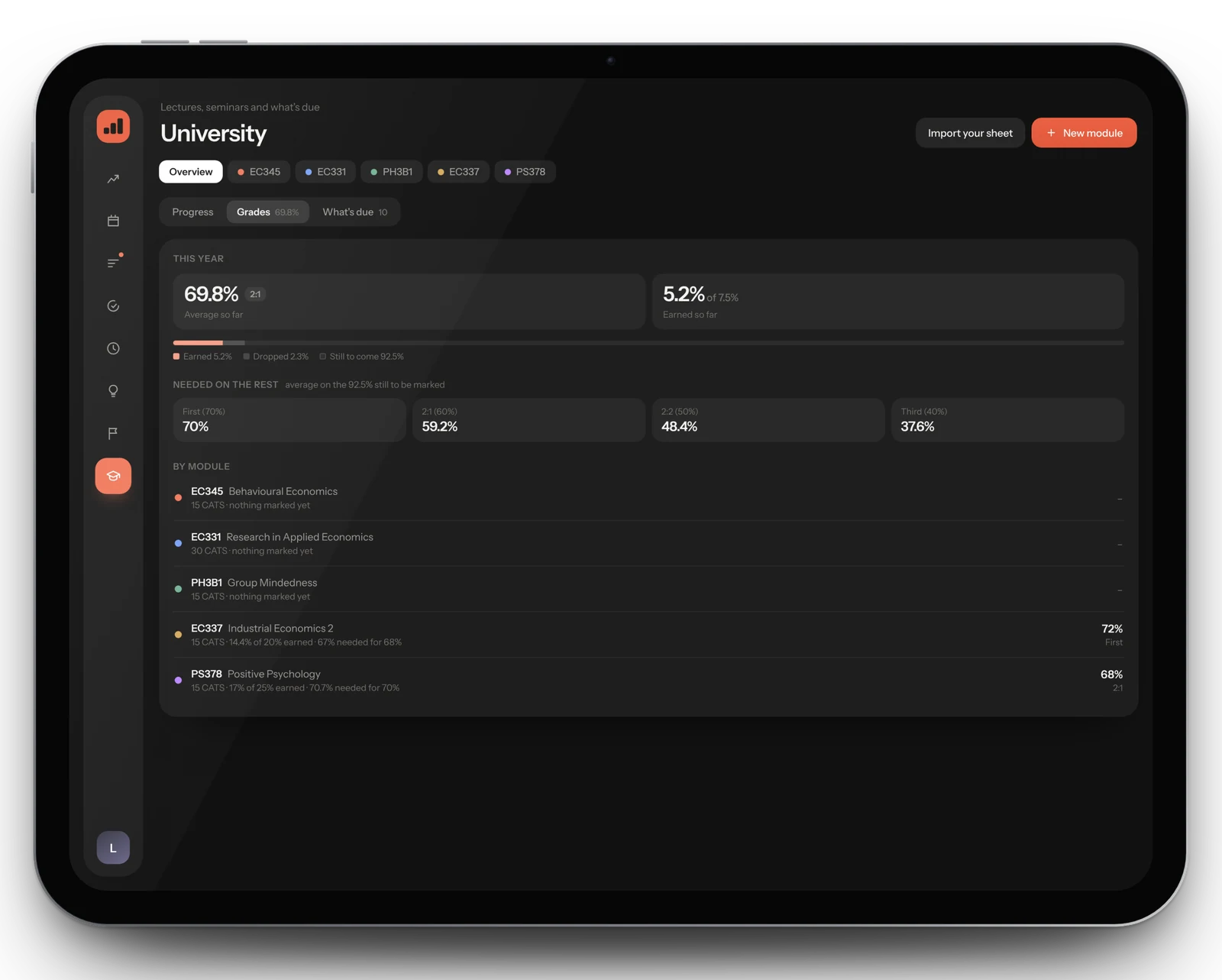
Ritual's University page holds your modules with their CATS, each assessment's weighting and mark, and every deadline. As marks come back, it works out your average so far and the average you need on the rest for a First, 2:1, 2:2, Third or your own target, for each module and the year. It shows the straight weighted average, so your university's borderline rule is still yours to check, which is what this guide is for.
- Your grade so far and what you need on the rest, by module and for the year
- Every lecture, seminar and deadline on your calendar, in its module's colour
- Your module tracker imported from Google Sheets or Excel, with a template if you're starting fresh
Ritual is in beta. Join the waitlist and you'll hear first when places open.
12Questions, answered
01Does first year count towards my degree?
Often not, but it depends on your university. At Bristol, Leeds and Swansea first-year marks don't count towards an honours classification, though you have to pass the year to progress, and for most Edinburgh degrees the first two of four years don't count. At LSE your first-year average makes up 2 of the 18 marks that decide your class, and some courses use a 10/30/60 split. Your course handbook or programme specification says which applies to you.
02Is 69.5% a First?
At some universities, yes. Leeds gives the higher class to averages within 0.5 of a boundary, UWE Bristol raises 69.5 to 69.9 automatically, and Bristol rounds the final mark to the nearest whole number. Under Warwick's convention for students who started in 2020/21 the average is kept to one decimal place, so 69.5 is a 2:1 that the exam board must reconsider as a borderline case. Check your own regulations.
03What is the borderline zone?
It's the band just below a class boundary where a university looks again at your marks before deciding your class. Sector guidance from Universities UK and GuildHE (2020) recommends a maximum of two percentage points below the boundary, so a 68 can be considered for a First but a 67.99 can't. Bristol, Swansea, Surrey and Warwick all use a two-point zone; Nottingham counts only a rounded 69, 59 or 49.
04What does preponderance mean in degree classification?
It means most of your marks are in the higher class. Universities that use it look at your credits inside the borderline zone: at Bristol you go up if 50% or more of your weighted marks are in the higher class, at Swansea if half or more of your counting credits are, and at Nottingham if two-thirds of your final-year credits (or of your last two years' credits) are.
05What does exit velocity mean?
It's the idea that your degree should reflect how well you were doing by the end. Universities build it in by weighting the final year more heavily, by counting only the final year, or by looking at your final-year average in a borderline case, as Swansea and Surrey do.
06Does a resit lower my degree classification?
It can. At Warwick and LSE, for example, a module or course passed at resit counts as 40 in the classification, whatever you scored on the resit. Mitigating circumstances work differently: if they're accepted, you may get a further first attempt without the cap. Check your university's rules before you decide how to handle a missed or failed assessment.
13Sources
All accessed 22 October 2026. Regulations change, and each applies to students who started in particular years, so check the current version for yours.
- Universities UK and GuildHE for UKSCQA, Principles for effective degree algorithm design (July 2020)
- Times Higher Education, "UK universities to limit rounding up of grades to prevent inflation" (21 July 2020), reporting the QAA's findings
- Office for Students, "Proportion of first class degrees falls for third consecutive year" (November 2025)
- Prospects, "Understanding university grades in the UK", citing HESA data for 2024/25
- University of Warwick, Degree Outcomes Statement 2025/26
- University of Warwick, Undergraduate mark scale and degree classification convention (students entering in 2020/21)
- University of Warwick, Credit and Module Framework
- QAA, Higher Education Credit Framework for England (second edition, 2021)
- University of Nottingham, Quality Manual: undergraduate degree classification from September 2020
- University of Bristol, A guide to degree classification
- University of Leeds, Classification
- University of Edinburgh, Degree classification
- UWE Bristol, Degree classifications
- University of Surrey, Academic and student regulations 2025/26, including the borderline amendment of 22 April 2026
- Swansea University, Undergraduate degree classification
- LSE, Three-year classification scheme for BA/BSc degrees, students from 2018/19 (updated August 2025)
Spotted a rule that's changed, or want your university added? Email hello@getritual.app. More in Guides.