
A day you haven't planned gets planned for you. Whatever's loudest takes the morning, the thing that actually matters gets pushed to the afternoon, and by the evening you're tired, it still isn't done, and it rolls into tomorrow. Do that for a week and you've been busy the whole time without moving the things you care about.
Planning the day properly fixes that. You decide in advance what gets your best hours, you stop making the same decisions over and over, and you know at every point what comes next. If the Sunday reset sets up the week, this is how you set up each day inside it.
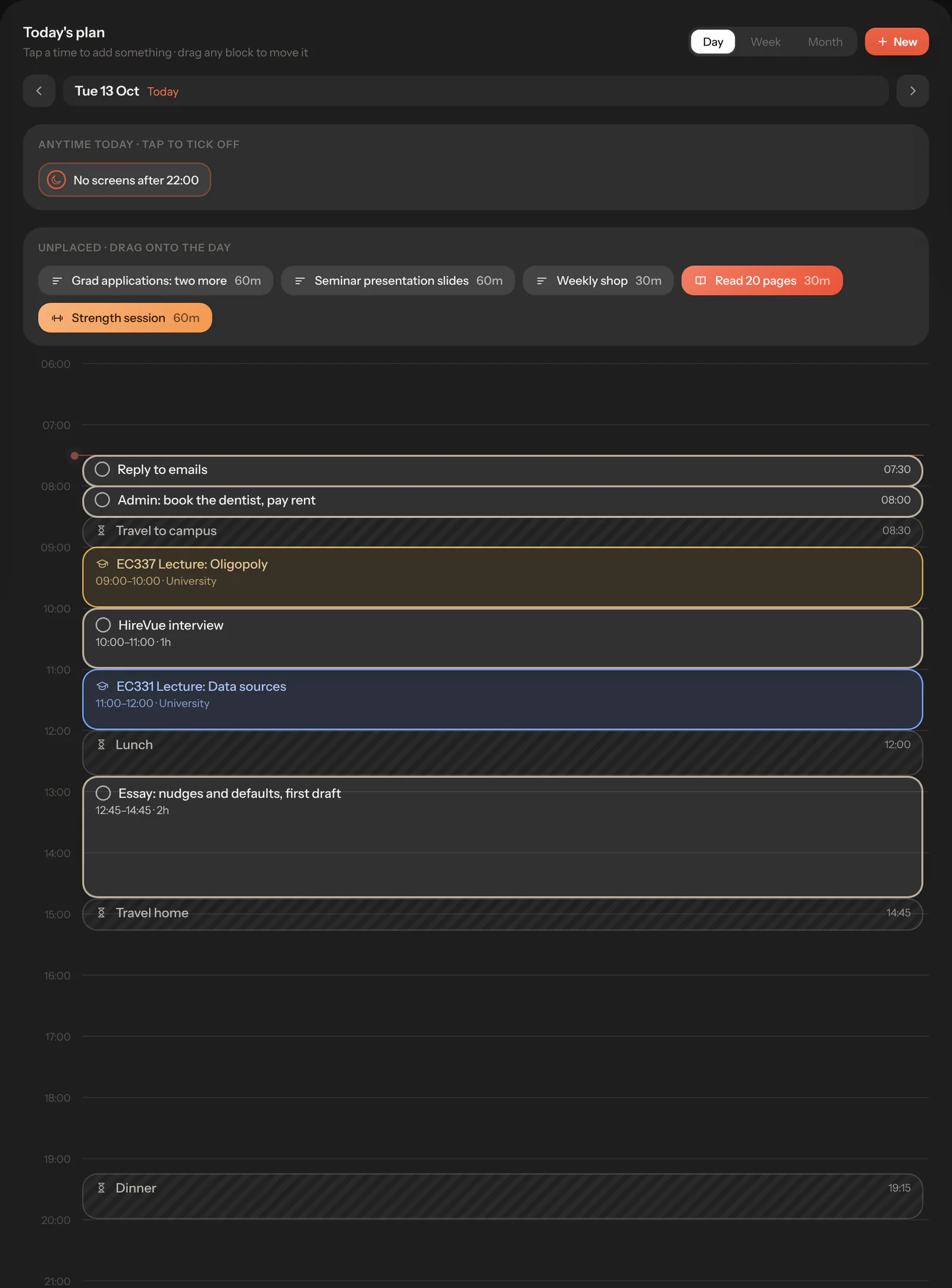
It happens in four steps. First, get everything that needs doing out of your head and onto one list. Then give each task the time it really needs. Then block out the things that are fixed. Only then do you build the day, and the order you build it in matters. I'll show it the way I do it, on one ordinary Tuesday in Ritual, from an empty calendar to a full day.
- Write everything down. Go through your emails, university and applications so nothing is missed.
- Give it real time. Plan each task for the work plus setup and breathing room, and point it at a goal.
- Block out the fixed things. Classes, meals and travel go in before any work does.
- Build the day in order. Quick wins first, your hardest task next with your phone away, then everything else where it suits you.
- Leave room, and re-plan rather than give up. A realistic day you finish beats an ambitious one you abandon by lunchtime.
01Write everything down
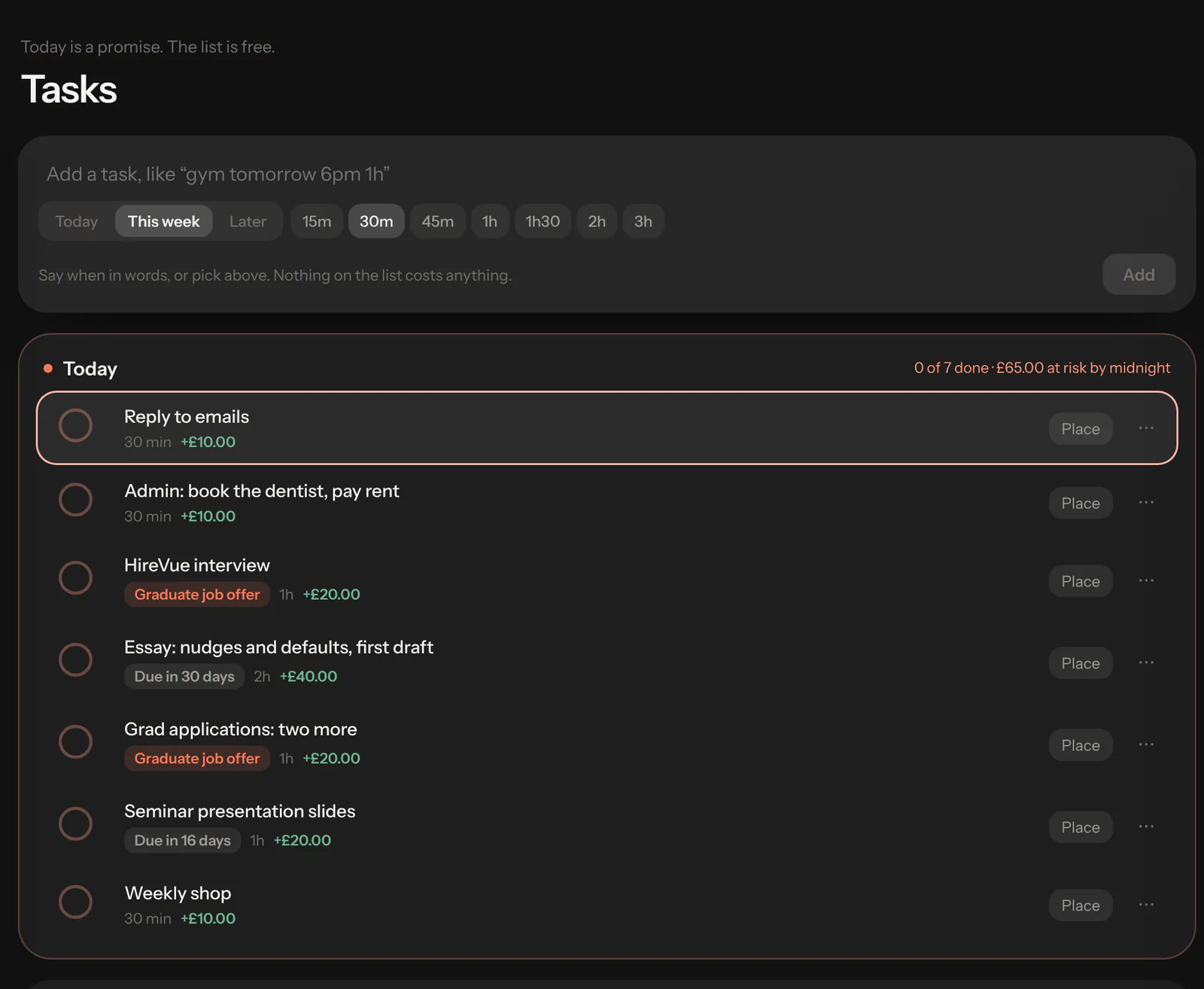
Start with the task list, not the calendar. Before you decide when anything happens, you need to know everything that has to happen, so jot it all down: big things, small things, the things you've been avoiding.
Then check it against everywhere work comes from. Go through your emails for anything you've been asked to do. Check your university deadlines and your applications, so the essay due in a few weeks and the online interview you've been sent are both on there. The aim is a list you trust, because if something isn't on it, it won't make it into the day.
02Give it real time
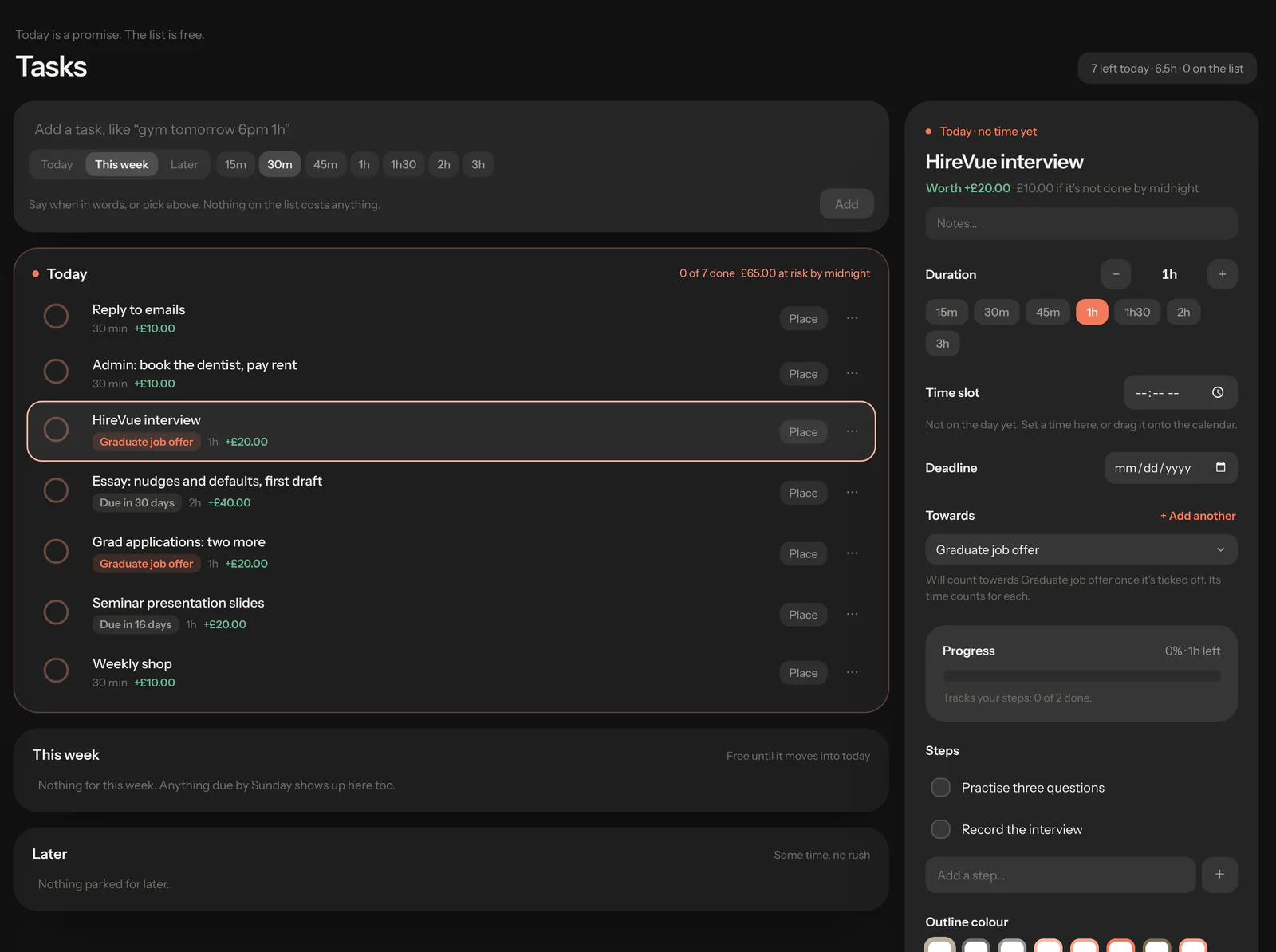
Next, give each task a length, and make it honest. If you only allow the exact time the work should take, you'll fall behind before lunch, because nobody works like a machine. You need a few minutes to set up, a few to get into it, and a breather before the next thing. So if a HireVue takes half an hour, give it an hour. If an essay draft should take an hour and a half, give it two.
This isn't being lazy. It's correcting for something everyone does. Psychologists call it the planning fallacy: we consistently underestimate how long our own tasks will take, even when we know similar ones have overrun before [1]. In one well-known study, students predicted their final-year theses would take about 34 days on average. They took about 56, and only around 30% finished within their own estimate [2].
While you're there, point each task at the goal it serves and break bigger ones into steps. The HireVue goes towards the graduate job I'm working for, with two steps: practise three questions, then record it. It's a small thing, but it means every task you finish visibly moves something you care about, and you can see exactly where the next step starts.
03Block out the fixed things
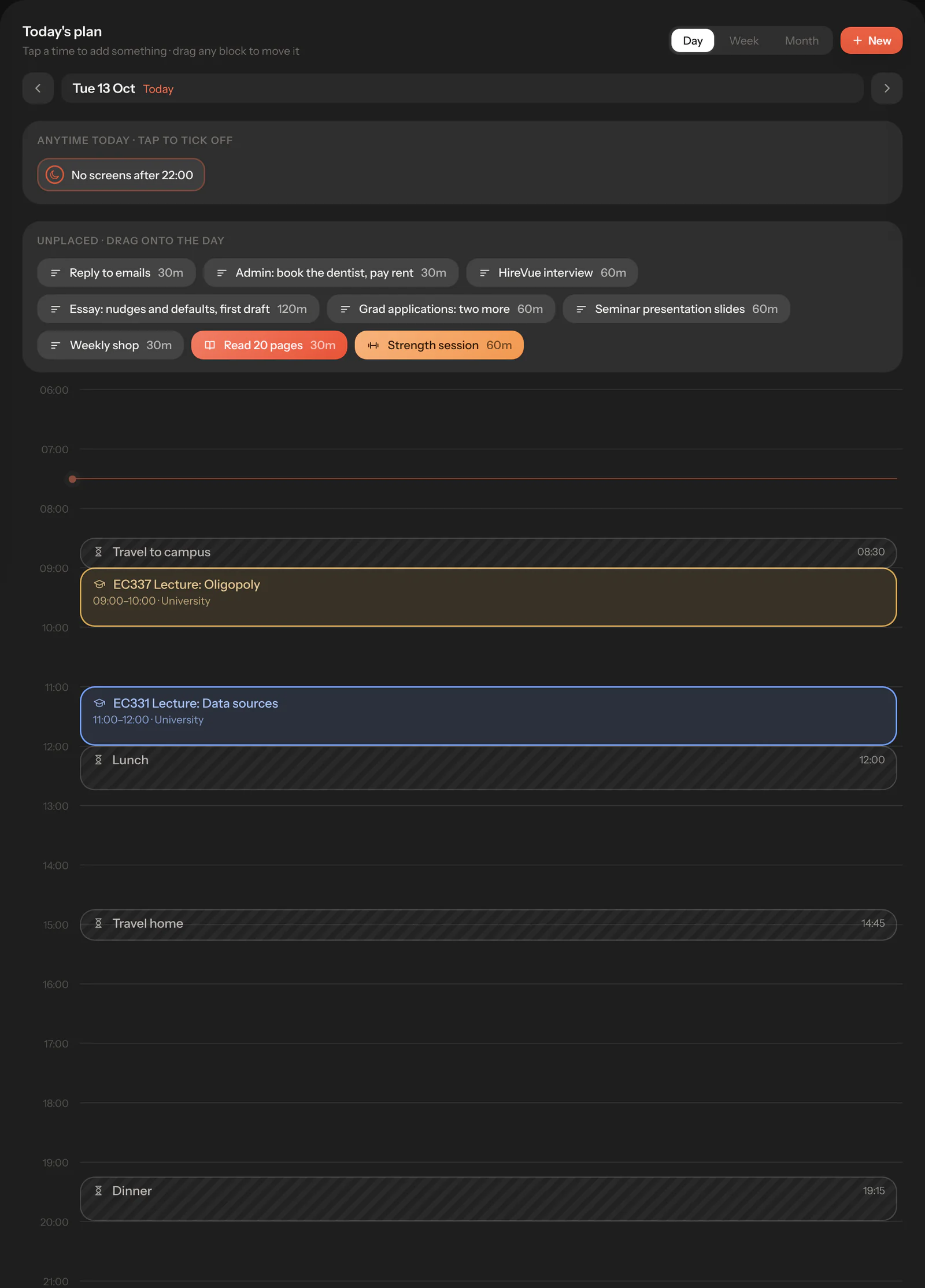
Now open the calendar, and before any work goes in, block out everything that's fixed. Classes come first. In Ritual they're already there, pulled through from the University page, so this Tuesday starts with two lectures at nine and eleven.
Then add placeholders for the time that isn't work but still has to happen: eating, travelling, getting to and from campus. They hold the time on your calendar without counting as tasks, so you can't accidentally plan over lunch. What's left between them is the time you actually have, and it's usually less than you'd assume.
04Build the day in order
Now you can plan the day itself. This is the structure I use. I've found it the most effective in my own days, and the research I've read points the same way.
Giving each task a specific slot matters in itself. Peter Gollwitzer calls plans like "at 10am, I start the HireVue" implementation intentions, and across 94 studies, deciding exactly when and where you'll act had a medium-to-large effect on people actually reaching their goals [7]. A task with a time is a decision you've already made.
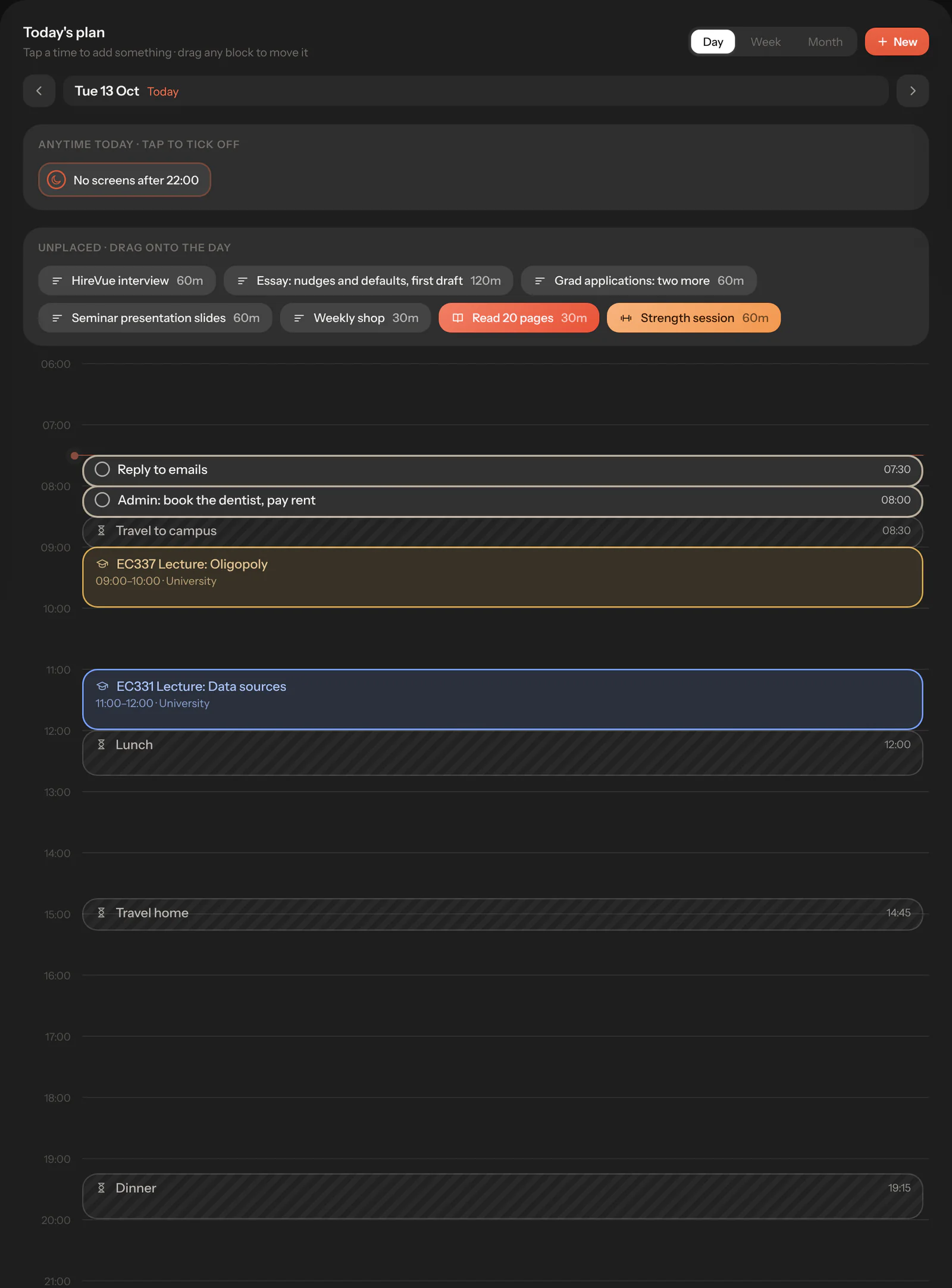
First: get the quick wins out of the way
Start with the five- and ten-minute tasks: emails, admin, planning, quick chores. They're small enough that there's nothing to put off and nothing to procrastinate on, they won't eat into the time for harder work, and they get them out of your head before they can distract you later. Most of all, they start the momentum. A few things ticked off early and your brain clears up.
There's research behind that feeling. Teresa Amabile and Steven Kramer studied the daily diaries of knowledge workers and found that of everything that lifts motivation and mood at work, nothing contributed more than making progress, even in small steps [3].
After that, keep the small stuff in batches. Rather than answering emails and messages all day, check them in set windows, say first thing, after lunch and late afternoon, so they don't leak into your best hours. When Kostadin Kushlev and Elizabeth Dunn had 124 people check their email only three times a day for a week, they reported less stress than in a week of checking whenever they liked [8].
Next: your hardest task
Then go straight into your hardest task, or tasks. These are the ones you've been dreading, the ones that take the most thinking, or the ones that take the longest. For me that might be HireVue practice and the HireVue itself, essay writing, or whatever I've been putting off for days.
Doing them now means you do them with the least mental fatigue, and it takes away the chance to put them off. Leave them until later and two things happen. You're more tired, so you keep pushing them back. Or you tell yourself you've already been productive today, so it feels less urgent. That second one is real: Ayelet Fishbach and Ravi Dhar found that making progress on a goal can leave people feeling free to do things that work against it [4]. And Piers Steel's review of procrastination research lists how unpleasant a task feels among the main things that predict putting it off [5]. Doing the hard thing first takes both out of play.
Do the hard thing while you're fresh.
Later, you'll find a reason not to.
Then protect that block. Put your phone in another room, turn notifications off, and close everything you don't need. It's the same idea as in the Sunday reset: make the right thing the easy thing. I start Ritual's focus timer on the task, so the block has a clear start, a clear finish and a break built in.
Last: fit in everything else
Finally, fit the rest of your tasks and habits in, in whatever order suits you. If you work best in the evenings, put some of the heavier remaining tasks there. If you fade after dinner, keep the evening for the easy ones and your habits. On this Tuesday that's the applications and the shop in the afternoon, the presentation slides before the gym, and twenty pages of reading after dinner.
Habits stick best when they're anchored to something that already happens. James Clear calls it habit stacking, with a simple formula: "After [current habit], I will [new habit]" [9]. That's why the gym comes straight after the last task of the afternoon and the reading straight after dinner. Each one has a cue it can't drift away from.
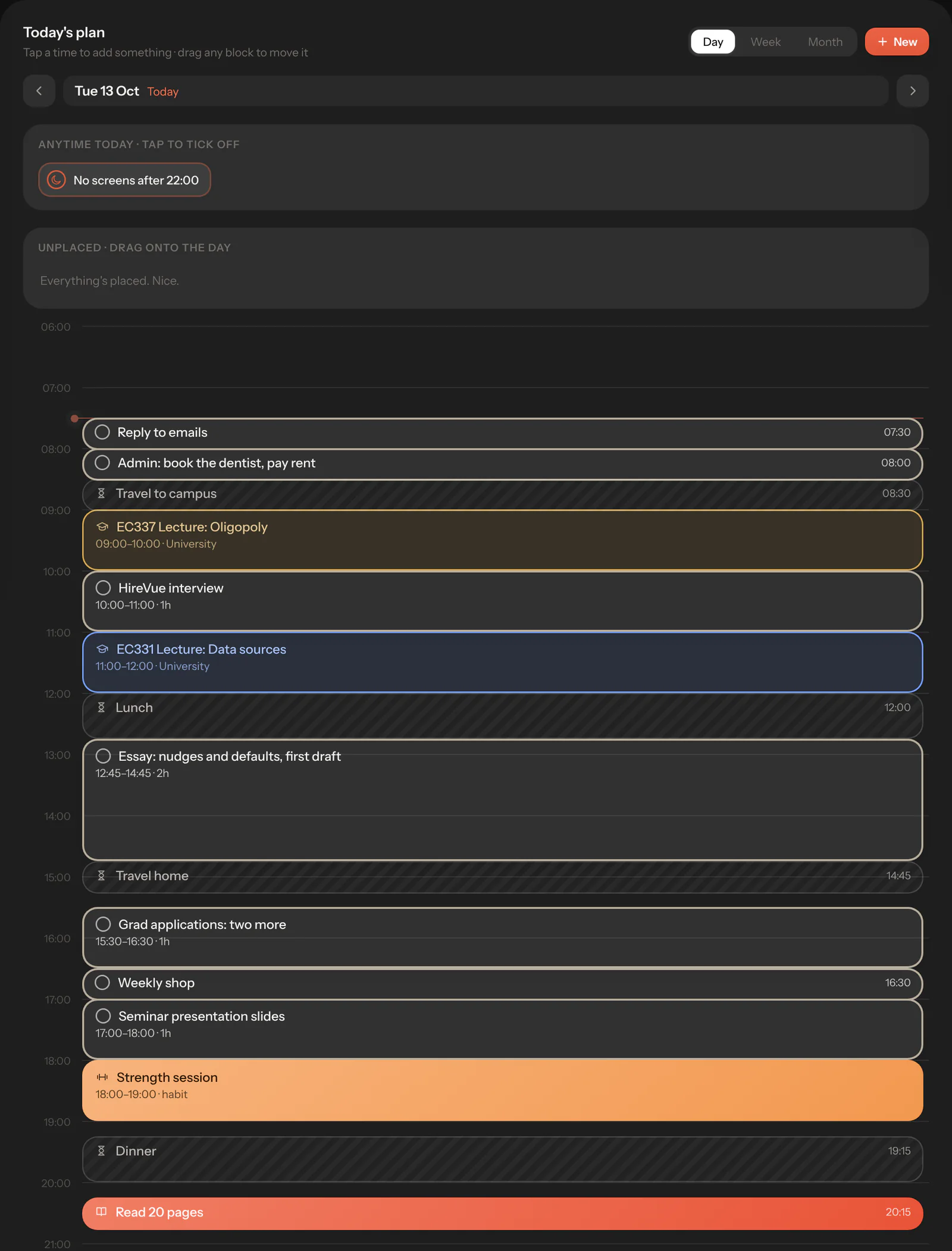
It's different for everyoneThis is the structure that works best for me, and the one the research I've read supports. Your energy might peak at a different time of day, or your days might have a different shape. Treat it as a starting point and adjust it until it fits you.
05Four rules that keep it alive
Leave breathing room
Be realistic about how much you can get done and how many breaks you need, and leave gaps between tasks. The danger isn't one task overrunning. It's what happens next: once you fall behind your plan, you stop looking at it, and once you stop looking at it, the rest of the day goes back to being whatever's loudest.
Don't overload the day
For the same reason, don't fill every hour. Finishing what you planned feels good, and that's what makes you want to plan again tomorrow. James Clear makes the same point in Atomic Habits: a habit sticks when it's satisfying [6]. Day after day of unfinished plans does the opposite. You start to expect not to finish, and the habit of planning quietly falls away. A smaller day you complete beats a bigger one you abandon.
Plan the day you'll actually have,
not the one you wish you had.
When the day goes off-plan, re-plan it
Some days it will. A lecture overruns, something urgent lands, you lose an hour. Don't scrap the day. At lunch, look at what's left, move one or two blocks, drop what genuinely can wait, and carry on from there. A day that's half rescued is far better than one abandoned at eleven o'clock, and it stops one bad morning turning into a bad week, which I wrote about in Keep moving. In Ritual you drag a block to its new time, and anything that still doesn't happen gets decided at the closing bell: tomorrow, back on the list, or dropped.
Plan at the same time every day
Plan either the night before or first thing in the morning, before you open your messages, so other people's priorities don't set your day for you. Doing it at the same time every day turns planning into a habit rather than something you have to remember. In Ritual, the closing bell at night decides what carries over, and the opening bell rings on your first open in the morning, so the plan takes about a minute.
06The day planner
If you'd rather plan on paper, or want to try the method before anything else, here's the whole thing on one A4 page: a list with time and goal columns, the three passes in order, and a time grid from seven to ten.
Download the day planner (PDF)
07How Ritual helps
Ritual is built around exactly this. Everything you need to do goes on one list, today is a promise and the rest is free until you move it in, and your classes, deadlines and applications sit on the same calendar as your tasks. The opening bell rings on your first open of the day: it shows you how much time is free, then lets you give each task a time, or drop it into the next free gap. Every task and habit you finish moves your own share price, so a well-planned day shows up as a number.
- One list for everything, with lengths, goals and steps on each task
- A calendar with your classes from the University page and placeholders for meals and travel
- An opening bell to plan the day in about a minute
Ritual is in beta. Join the waitlist and you'll hear first when places open.
08Questions
01How do I plan my day effectively?
Write down everything that needs doing, give each task its real time plus room to set up and breathe, block out the fixed things like classes, meals and travel, then place the work: quick tasks first, your hardest task next, and everything else where it suits you.
02What should I do first in the day?
A few quick tasks of five or ten minutes, like emails, admin or a small chore. They're too short to put off, they give you some early wins, and they clear your head. Then go straight into your hardest task while you're fresh.
03How long should I give each task?
Longer than the task itself. If the work takes an hour, plan for an hour and a quarter or more, so there's time to set up, get into it and take a breath before the next thing. People reliably underestimate how long tasks take.
04Why do I never finish my plan?
Usually because the plan was too full. Leave breathing room between tasks and don't put in more than you can realistically do. A plan you finish builds the habit; a plan you keep falling behind on is one you stop looking at.
05Should I plan my day the night before or in the morning?
Either works, as long as it's the same time every day and before you open your messages. Planning the night before means you wake up knowing what's first. Planning first thing means you plan with the day's news in front of you.
06What should I do when my day doesn't go to plan?
Re-plan it rather than abandon it. Look at what's left, move one or two blocks, drop what can wait and carry on. A half-rescued day is far better than one given up at eleven o'clock.
09Sources
All accessed 26 October 2026.
- Society for Personality and Social Psychology, "The planning fallacy" (Roger Buehler)
- Buehler, Griffin and Ross, "Exploring the planning fallacy", Journal of Personality and Social Psychology (1994)
- Teresa Amabile and Steven Kramer, "The Power of Small Wins", Harvard Business Review (2011)
- Ayelet Fishbach and Ravi Dhar, "Goals as Excuses or Guides", Journal of Consumer Research (2005)
- ScienceDaily, on Piers Steel, "The nature of procrastination", Psychological Bulletin (2007)
- James Clear, Atomic Habits summary: the fourth law, make it satisfying
- Gollwitzer and Sheeran, "Implementation Intentions and Goal Achievement: A Meta-analysis of Effects and Processes" (2006)
- PsyPost, on Kushlev and Dunn, "Checking email less frequently reduces stress", Computers in Human Behavior (2015)
- James Clear, "Habit Stacking: How to Build New Habits by Taking Advantage of Old Ones"
Something here out of date, or a question the guide doesn't answer? Email hello@getritual.app. More in Guides.