
It's the CV I've sent, lightly tailored, to graduate schemes in banking, consulting, trading and asset management. The excerpts below are real lines from it, with the names of the companies taken out, and you can see the whole page just before the template.
- One page, and not too dense. Concise and straightforward. If it only fits by squeezing, cut a line.
- No profile at the top. The space goes to evidence.
- Keep education short. Degree, A-levels, GCSEs and any prize or certificate. The bulk of the page is your experience.
- Experience, most recent and most relevant first, with a number and an outcome on every bullet.
- Show your skills inside the bullets. Don't list them. The skills line is only for technical skills the rest of the page hasn't shown.
- Make your extracurriculars count: results, numbers and what you contributed to the team or society.
- Keep the formatting completely consistent, from the dates to the bullet points.
01One page, not too dense
General UK advice allows two pages: Prospects quotes the University of Chester careers team, "We recommend CVs are no longer than two A4 pages" (Prospects). Finance is stricter. LSE Careers says investment banks "have a reputation for only accepting one page", and that "if you're just starting out, one page may be sufficient" (LSE Careers). Bath's careers blog recommends one page for roles in an investment bank, where "it's generally accepted that this is preferred" (University of Bath). And Bright Network's advice is blunter still: "Your CV shouldn't be more than a page at this point in your career" (Bright Network).
For spring weeks, internships and grad schemes in finance or consulting, I use one page. Keep everything concise and straightforward, and don't squeeze things in. A page with narrow margins, a tiny font and no white space is harder to read than one with a line less on it. If it doesn't fit, cut the weakest line rather than shrinking everything else.
02The layout
My CV has five parts, in this order.
1. The header. Your name, then one line with mobile, email and LinkedIn. No photo and no date of birth: Prospects says date of birth "is irrelevant", and that a photo isn't needed outside acting or modelling (Prospects). Prospects suggests a home address, but says to leave it off if you post your CV online, "as you could be targeted by fraudsters". I leave mine off to save a line.
No profile. I don't put a personal statement or summary under the header. It's the part of a CV that reads most alike from one applicant to the next, the cover letter or application form already does its job, and the lines are worth more as evidence.
2. Education. Keep it short. University, degree, dates and predicted grade, plus a qualification, certificate or relevant coursework if you have something worth naming (I put my financial modelling certification here). Then school: A-levels with grades, GCSEs, and any scholarship, prize or award. Graduate postings still check A-levels and GCSEs, so include them, but this section should take up a small part of the page.
3. Work experience. Your most recent and most relevant experience, in reverse chronological order. Role and firm on the left, dates right-aligned, three to six bullets each.
4. Extracurricular activities and positions of responsibility. Leadership, sport, societies and anything you've built or started.
5. Skills. One or two short lines of technical skills and software.
Education or experience first? I put a short education section first because it's what I'm used to, and graduate postings check the basics quickly: ExxonMobil's London trading graduate posting, for example, asks for "at least a 2:1 degree in any subject" (ExxonMobil). But the order matters less than the balance. Your work experience should be the bulk of the page. If your experience is the stronger part of your story, put it first; Prospects suggests exactly that when you have "plenty of relevant work experience" (Prospects).
03Every bullet: a number and an outcome
Every bullet I'm happy with follows the same pattern: a verb, what you did, the scale, and the outcome or why it mattered.
From my CV"Screened 200+ companies across 5 sectors within 48 hours per mandate, delivering origination shortlists directly to the Head of Origination to enable same-week outreach."
- Verb: screened.
- What: companies, for origination shortlists.
- Scale: 200+, 5 sectors, 48 hours.
- Outcome: the shortlists went straight to the head of the team and enabled outreach that week.
Use numbers wherever you have them: how many, how fast, how much it changed and who it went to. A bullet without an outcome describes a task. A bullet with one describes a result.
From my CV"Built pricing models analysing 3 years of cost data across regional markets, identifying more cost-efficient project routing and improving cost efficiency by ~15%."
Employers ask for exactly this. J.P. Morgan's hiring page says to show what you've accomplished "using measurable data when applicable" (J.P. Morgan). TargetJobs, writing about McKinsey, says it wants to know "why your work mattered" and the changes you brought about (TargetJobs).
Rules I follow:
- Start each bullet with a different strong verb: executed, built, screened, managed, authored, analysed. Avoid "helped with" and "responsible for".
- Use numbers you can defend in an interview. "15+ mandates" is a count I can list. "~15%" is fine only if I can explain the baseline.
- Name the technical thing. "Precedent transaction analysis", "lock box and completion account mechanics", "financial and tax due diligence". Screeners in finance recognise these. Spell out anything a non-specialist recruiter might not know.
- Don't name clients or deals unless they're public and you're allowed to. My own CV names the deals I worked on, because they were announced. Here I've taken the company names out:
From my CV"Executed workstreams for the closed sale of [a founder-led business] to [a private equity buyer], contributing precedent transaction analysis, valuation range and IM materials through to completion."
If you're not sure a deal is public, describe it instead of naming it ("the sale of a founder-owned services business to a private equity buyer"). The reader learns the same thing about you, and you haven't broken anyone's confidence.
04Show skills, don't list them
Never just state a skill. "Strong analytical skills" or "proficient in Excel" on its own tells a recruiter nothing, because everyone writes it. Build the skill into the bullet where you used it, so the evidence comes with it:
Listed"Skills: Excel, financial modelling, attention to detail."
Shown"Screened 200+ companies in Excel and Capital IQ across 5 sectors within 48 hours per mandate…"
Every skill you mention should have a place: a task it was used for and what came of it. If you can't point to one, it probably doesn't belong on the page.
The skills section at the bottom is then short. Keep it to important technical skills and software that aren't cliché and that the rest of the CV hasn't already shown: the modelling methods, data tools or platforms a screener would look for. Leave out "communication", "teamwork" and "problem-solving". Your bullets should already prove those.
05Extracurriculars that count
Give this section real space, and treat it like work experience. If something is measurable, say so, and say what you contributed to the team, the society or the project.
From my CV"Football First XI, Whitgift School: member of the teams that won the U15 and U17 Independent Schools National Football titles."
From my CV"Built an online personal training business, acquiring a client base and generating £1,200+ revenue in the first month."
The first shows what a team achieved with you in it, with a result attached. The second shows commercial thinking with a number. Neither needs the words "teamwork" or "entrepreneurial" to make its point.
For a society, the same rules apply: what you did for it, and what changed. "Treasurer" is a title. "Treasurer: ran a £[n] budget and secured [n] sponsors" is a contribution.
06Keep the format completely consistent
A screener notices inconsistency before they've read a word. Pick one format and use it everywhere:
- one date format (e.g. "Sep 2025 – May 2026"), right-aligned on every line;
- role and organisation in the same place and style for every entry, with the organisation in bold;
- the same bullet style, the same indent and the same tense: past for finished roles, present for current ones;
- one font, at a size between 10 and 12, with bold headings (Prospects);
- either full stops at the end of every bullet or none.
Then send it in the file type the employer asks for. Bain's portal, for one, accepts "Word doc or PDF files only" (Bain & Company). Prospects also warns that "not all ATS' are compatible with a PDF", so check which format each firm wants.
Proofread for the small things: typos, US spellings ("synthesizing" for "synthesising"), mixed date formats and missing full stops. Prospects suggests temporarily changing the font, size and colour, reading it aloud, or reading it from bottom to top to catch them. Check the file name too, because recruiters see it before they open the file.
07Weak lines, and the fix
Three patterns that turn up on a lot of student CVs. The "after" versions are templates: fill them with real figures, and don't invent numbers to complete them.
1. The one-week insight programme that sounds like a job.
Before"Produced research on market trends that shaped the team's strategy."
After"One-week insight programme: researched [topic] and presented a short note to [team]."
Claiming impact from a week of work invites a question you can't answer well. One honest line says more.
2. The number nobody can check.
Before"Helped improve customer satisfaction by 25%."
After"Ran a customer survey ([n] responses); its findings led to [specific change]."
"Customer satisfaction" has no unit. Count what you can actually count, and keep the percentage only if you can explain how it was measured.
3. The project with no result.
Before"Developing a budgeting app with five features, launching soon."
Afteronce there's a number, lead with it: "Built and launched [app]: [n] users in [period]."
"Launching soon" describes effort. A number describes an outcome.
08The cover letter rules apply here too
Most of the cover letter method holds for a CV:
- Every detail needs a purpose. If you can't say why a line is there, cut it.
- Numbers must be real. Rounded is fine. Invented isn't, and every figure is a question you've invited at interview.
- Never overstate your involvement. "Took two deals through to completion" becomes "contributed to diligence on two processes at their later stages" if that's what happened.
- Keep your CV and letters consistent. Interviewers read both. Anything you lean on in a letter, such as a side project or trading on your own account, should be on the CV, and the two should describe the same work the same way.
- Tailor the order, not the facts. Reorder the bullets for each sector: valuation first for banking, research and client work for consulting, markets and risk for trading.
09My CV, in full
Here's the whole page, so you can see how the rules above fit together on one sheet.
Louis Baverstock
mobile | email | LinkedIn
Education
- Degree: BSc Economics, Psychology and Philosophy (EPP) | Predicted first class honours.
- Relevant Coursework: Behavioural Economics, Financial Markets, and Strategic Decision-Making.
- Corporate Finance Institute FMVA: Financial modelling & valuation (DCF, 3-statement, comps).
- A Level: Economics (A*); Psychology (A*); Mathematics (A*).
- Extended Project Qualification (A*): “The Marketisation of The Organ Trade”.
- GCSE: 10 A* GCSEs - 8 x Grade 9s, 2 x Grade 8s; Including English Language (9) and Mathematics (9).
- All-round Scholarship (Academic & Sports).
- A-level Psychology Attainment Award: Awarded top student prize for achieving highest A-level mark.
Work experience
- Executed workstreams for the closed sale of client to private equity buyer, contributing precedent transaction analysis, valuation range and IM materials through to completion.
- Facilitated financial and tax DD on client through to close, stress-testing models and surfacing accounting discrepancies for the deal team.
- Managed lock box and completion account mechanics on a live transaction, reconciling financial data before closing.
- Built valuation analyses across 15+ mandates using 30+ comps and precedent transactions per mandate to benchmark EBITDA margins, revenue growth and trading multiples.
- Authored client-ready IM materials across 10+ successful pitches, synthesising market dynamics, competitive positioning and sector analysis to secure client engagements.
- Screened 200+ companies across 5 sectors within 48 hours per mandate, delivering origination shortlists directly to the Head of Origination to enable same-week outreach.
- Built pricing models analysing 3 years of cost data across regional markets, identifying more cost-efficient project routing and improving cost efficiency by ~15%.
- Developed an Excel-based tracking system for EV infrastructure projects, cutting project timelines by ~10%.
- Analysed regional performance, ICP bid success rate and competing IDNOs to enhance business strategies.
- Designed surveys that helped to enhance service quality by 20%, aligning client expectations with deliverables.
- Analysed financials, market positioning, and competitive dynamics to inform equity selection and portfolio strategy decisions.
- Delivered reports on market trends and behavioural finance, impacting strategies and consultations.
- Supported meetings with research insights, assisting senior staff in delivering tailored solutions.
Extracurricular activities & positions of responsibility
- Independently developed Ritual, a productivity app integrating 6 core modules and gamifying task completion through a personal share-price system, ahead of launch.
- Mentored underprivileged students and supervised international cohorts across two summer programmes at Whitgift School.
- Football First XI member at Whitgift School, part of the team that won the U15 and U17 Independent Schools National Football titles.
- Founded and operated a print-on-demand Etsy store, generating £1,000+ revenue in the first month.
- Built an online personal training business, acquiring a client base and generating £1,200+ revenue in the first month.
Skills
- Technical: Advanced Excel, Financial Modelling, Valuation Analysis.
- Software: Capital IQ, Mergermarket, PitchBook, Microsoft PowerPoint.
Most of the work bullets carry a number and an outcome. Education sits at the top with the grades and awards that matter, but the bulk of the page goes to experience. And every extracurricular has something concrete attached: titles won, revenue in the first month, an app built.
10A template
FIRSTNAME LASTNAME
Mobile | Email | LinkedIn
EDUCATION
University, City | Month Year – Month Year
• Degree: degree | Predicted grade
• Qualification, certificate or relevant coursework
School, Town | Year – Year
• A-levels: subjects and grades | GCSEs: number and grades
• Scholarship, prize or award
WORK EXPERIENCE
Role, Organisation | Month Year – Month Year
• Verb what, scale, outcome or why it mattered
• Verb what using tool or method, scale, outcome
• Technical bullet: the method, how many times, what it fed into
• Who saw your work, or what it fed into, with a number
Role, Organisation | Month Year – Month Year
• Verb what, scale, outcome or why it mattered
• Verb what using tool or method, scale, outcome
• A result you can measure: a percentage, a time saved, a figure
EXTRACURRICULAR ACTIVITIES & POSITIONS OF RESPONSIBILITY
• Role in a team or society, your contribution, result
• Something you built or started, number
SKILLS
• Technical: methods not already shown above, e.g. 3-statement and DCF models
• Software: platforms and tools
First-year spring week version: the same layout. With less experience to show, school, part-time jobs, sport and societies carry more of the page, so write each with the same bullet formula: what you did, the number and the result. Spring week applications usually open in late August or early September, and most close in December or early January (Warwick Business School), so have it ready before term starts.
11How Ritual helps
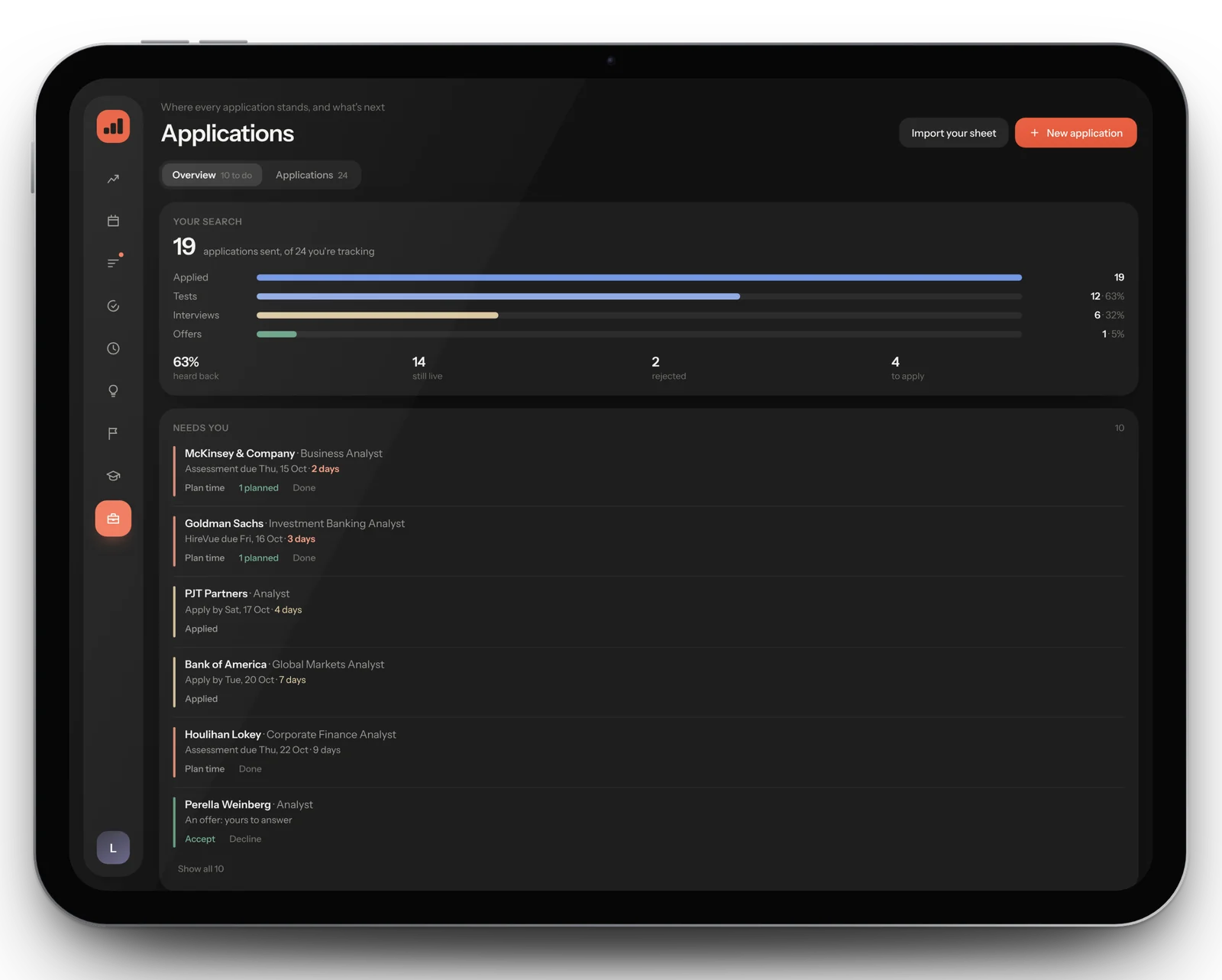
A CV is half the job. The other half is not losing track of where it's gone. Ritual's Applications page keeps every application in one place. Bring in the spreadsheet you already use (Excel, CSV or a Google Sheet link) and it reads your own status wording into stages: applied, a test or HireVue to do, interview, assessment centre, offer, rejected or no reply.
- Deadlines and test due dates on your calendar
- A "needs you" list: tests to finish, deadlines coming up and anything that's been quiet for three weeks
- Searchable notes on each application, for which version of your CV went there
- A pipeline of how many reached a test, an interview or an offer
Ritual is in beta. Join the waitlist and you'll hear first when places open.
12Questions, answered
01Should a graduate CV be one page or two?
For finance and consulting, I'd use one page. General UK advice allows up to two, but one page forces you to cut the weak lines. Keep it concise, and don't cram: if it only fits by shrinking the font and margins, cut a line instead.
02Do I need a personal statement or profile at the top of my CV?
No. On a one-page CV for finance or consulting, skip it. The cover letter or application form does that job, and the space is worth more as evidence.
03Should I include A-levels and GCSEs on a graduate CV?
Yes. Include A-levels with grades, your GCSEs, and any prizes, scholarships or certificates. Graduate schemes still check them, and they're quick to read.
04Should education or work experience come first on a student CV?
Either works. Many students keep a short education section at the top because postings check the basics quickly, but your work experience should be the bulk of the page. If your experience is the stronger part of your story, put it first.
05Should I have a skills section on my CV?
A short one. Show most skills inside your bullets, where you used them and what came of it. Keep the skills line for technical skills and software the rest of the page hasn't shown, and leave out soft skills like communication and teamwork.
06Is "predicted First" OK on a CV?
Yes, if it's your university's or tutor's prediction and you're comfortable defending it. Use whatever your university gives you, and don't upgrade it.
07Can I use AI on my CV?
Check each firm's rules. Bain's London page asks applicants to "only use AI, such as Chat GPT or Claude, to check grammar and spelling in your CV", and doesn't allow it in the assessment or interviews.
13Sources
All accessed 22 October 2026. Requirements change every recruiting cycle, so check the live posting.
- Prospects, "How to write a CV"
- TargetJobs, applying to McKinsey: CVs, cover letters and interviews
- J.P. Morgan, How we hire
- ExxonMobil, Global Trading Commercial Graduate, London
- Bain & Company, Associate Consultant hiring process
- Bain & Company, London recruiting
- LSE Careers blog, "One page or two? How long does my CV need to be?"
- University of Bath Careers blog, "CVs: one page or two?"
- Bright Network, CV templates
- Warwick Business School, "Spring week internships: the complete guide"
Something here out of date, or a question the guide doesn't answer? Email hello@getritual.app. More in Guides.