
If you're in your first year and people on your course have started talking about spring weeks, this is the guide to read before you open an application. It's built from what employers and university careers services say themselves. It doesn't list live deadlines, because they change every year, so for current openings use the sites in where to find spring weeks.
- A spring week is a short insight programme, usually between two days and two weeks around Easter, run mostly by banks but also by law, consulting, accountancy and tech firms.
- It's aimed at first-years on three-year courses and second-years on four-year courses, and many programmes take any degree subject.
- Applications usually open in August or September, and many firms fill places as applications arrive, so the real deadline can come before the advertised one.
- Expect an online form, online tests and a video interview, and at some firms a final interview or assessment morning.
- Strong attendees can be fast-tracked towards a summer internship at the same firm, but each firm decides how that works.
- You can still get an internship without one.
01What is a spring week?
A spring week is a short, structured work experience programme that introduces first-year university students to an employer and its industry. Most run over the Easter break and last from a couple of days to two weeks, and in investment banking they're seen as the first step into the profession [1] [2].
TargetJobs notes that the term is "particularly associated with investment banking" [1]. You'll also see spring insight programmes, insight weeks and first-year internships, and many firms give theirs a brand name. Whatever the label, the firm is using the time to show you what the work looks like and to get an early look at you.
Length varies more than the name suggests. Warwick Business School's careers guide puts most spring weeks at one to two weeks in March or April [2], but shorter ones are common: Standard Chartered's 2027 UK programme runs for three days, from 6 to 8 April 2027 [3], and the law firm Simmons & Simmons runs a two-day scheme on 20 and 21 April 2027 [4]. Most are held in person, though a few firms run virtual versions, and some insight programmes happen in the autumn or at Christmas instead of the spring [1].
They aren't only for would-be bankers. Insight programmes are mostly run by large employers in law, investment banking, fintech, accountancy and consulting [1], and you'll also find them in asset management and technology [2].
02Who can apply for a spring week?
Spring weeks are aimed at first-year students on three-year degrees and second-year students on four-year degrees. Many are open to any degree subject, and most don't expect you to have worked in the industry before [1] [3].
Standard Chartered's 2027 programme is a typical example of the wording. It's for "first year university students (or second year if on a four-year course)", from "any degree discipline", with "no prior banking or financial services experience required" [3].
Some programmes reach further. TargetJobs points out that some are open to students in any year from groups underrepresented in a profession, and that a few, particularly in law, take graduates and postgraduates [1]. Simmons & Simmons' 2027 scheme takes first-year law and non-law students and penultimate-year non-law students [4], and CMS's 2027 insight programme takes first-year law students and penultimate-year non-law students [5]. So if you're past first year, check before assuming you've missed out.
Your grades still matter. Warwick Business School's careers team suggests making the most of your A-level results and how you're doing in your degree so far [2]. First-year marks often don't count towards your final degree class (the degree classifications guide explains which years do), but an application can still ask for them, so keep an eye on your average as marks come back. The degree calculator works it out for you.
03When do spring week applications open?
Most spring week applications open in August or September of the year before the programme, so places for spring 2027 started opening in late summer 2026 [2]. Closing dates vary by firm, and because many firms review applications as they arrive and close once places are filled, the real deadline can come before the advertised one [1].
TargetJobs advises applying as early as you can for that reason [1]. In the three listings below, closing dates run from mid-November to New Year's Eve, and one programme later in the year doesn't open until January [3] [4] [5].
| Firm | Sector | Programme dates | Applications | Who can apply |
|---|---|---|---|---|
| Standard Chartered [3] | Corporate and investment banking | 6 to 8 April 2027, London | Apply by 15 November 2026 | First-years, or second-years on four-year courses, any degree |
| Simmons & Simmons [4] | Law | 20 and 21 April 2027, London | Close 31 December 2026 | First-year law and non-law students, penultimate-year non-law students |
| CMS [5] | Law | 14 to 18 June 2027, four UK offices | Open 29 January 2027 | First-year law students, penultimate-year non-law students |
Treat the table as an example of the pattern. Dates change every year, and the sites in where to find them keep up with that.
Wonkhe's write-up of the Institute of Student Employers' 2026 survey also notes employers moving to shorter application windows and limiting how many roles one person can apply for at a single firm [9]. If a firm only lets you apply to one programme, pick the division you really want.
04The spring week application process
Most spring week applications are a shorter version of the firm's graduate process: an online form, then online tests, then a video interview, and at some firms a final interview or assessment morning. Some law and consulting firms ask for a CV and a short interview instead [1] [2].
| Stage | What it involves | What it's testing |
|---|---|---|
| Application form | Your details, education and experience, a CV and sometimes a cover letter, plus questions such as why this firm and why this career | Whether you've researched the firm and can explain why you're applying |
| Online tests | Usually numerical and logical reasoning, timed | Accuracy and reasoning under time pressure |
| Video interview | Pre-recorded questions shown on screen, with a short time to think and a set time to answer each one | How clearly you explain your motivation and back it up with examples |
| Final round | One or two interviews, often HR and then someone from the business, or an assessment morning | How you think on your feet and how you work with other people |
The form is where a lot of people lose marks they didn't need to. The CV you attach should fit on one page with a number and an outcome on every line, which the one-page CV guide walks through. If a firm asks for a cover letter or a written answer to "why us?", the cover letter method shows how to research a firm before you write a word. Recruiters don't expect a first-year to be committed to the career yet, but they do expect genuine interest and some knowledge of the employer [1].
Online tests deserve the same care, because a weak score usually ends the application. Exeter's careers guide says banks always include numerical and logical reasoning, and recommends practising first, for example through your careers service [6].
Video interviews are usually pre-recorded. A common format, as Exeter's guide describes it, is around ten questions shown one at a time, with 30 seconds to think and 90 to 120 seconds to answer, completed within a window the firm sets [6]. Check the deadline as soon as the invitation arrives and put a time in your calendar to do it somewhere quiet.
The final round varies the most from firm to firm. It might be one or two interviews, often an HR interview followed by one with someone from the business, or a full assessment morning [6]. Early interviews with HR tend to be about you and your motivation more than about markets [6], so know your own story well, including a real example for each skill you say you have.
All of this takes longer than people expect. Exeter's guide puts a full application, tests included, at anything from a couple of hours to four or five, though you get quicker as you go [6]. Count that time in when you decide how many to do in a week.
05What happens during a spring week?
On a spring week you'll usually hear talks about the firm and its divisions, meet graduates and senior staff, work through a case study with other students and shadow people at their desks. At firms that use the week for internship hiring, how you do on it can count towards what comes next [1] [3].
TargetJobs lists what most programmes include: formal talks, informal chats with graduates and senior people, a case study or a walk-through of a recent piece of work, skills workshops such as commercial awareness, advice from recruiters on making applications, and shadowing or simple tasks. On longer programmes you're likely to rotate around different divisions [1]. Standard Chartered's 2027 programme includes business deep dives, sessions with leaders and graduates, and job shadowing [3].
To prepare, read up on the firm and its recent news, come with questions for the people you'll meet, and have a short introduction ready for the networking sessions [1]. Take a notepad and pen, and check the dress code in the briefing pack [1].
In my placement-year guide I wrote that "a spring week or a short summer internship is gentler, because there's more structure around you and more of the time is set aside for learning." Make use of that structure. Ask the questions you'd feel awkward asking once you're an intern, write down the names of the people you meet, and connect with them on LinkedIn afterwards, as TargetJobs suggests [1].
06Are spring weeks paid?
Some spring weeks are paid and some aren't. Many unpaid programmes cover travel and accommodation instead, and one-day insight events are more likely to be expenses-only [1]. Standard Chartered's 2027 programme, for example, is unpaid but reimburses travel and accommodation for students from outside the London area [3].
The rules explain why. GOV.UK says an employer doesn't have to pay the minimum wage if an internship only involves shadowing, meaning no work is carried out and the intern is only observing [7]. A spring week is mostly talks, workshops and shadowing, so pay is up to the firm. Each listing should say what's covered, and if it doesn't, ask before you book a train or a room.
07Do spring weeks lead to internships?
A spring week can lead to a summer internship at the same firm, because many firms run them to find future interns. Strong attendees may be offered an internship place or fast-tracked to a later stage of the internship process, but each firm decides how that works and nothing is guaranteed [1].
TargetJobs puts it this way: if you make a great impression, you're "likely to be offered a place on their internship the following year", or at the very least "fast-tracked to the final interview or assessment centre stage" [1]. Firms use their own wording, so read it closely. Standard Chartered says attendees who perform well will be "first in line" for its 2028 summer internship [3], and CMS says completing its programme means you "could be fast-tracked" to an assessment day for a training contract [5].
The timeline is longer than it looks. If you do a spring week in April 2027 in your first year, the internship it feeds into runs in summer 2028, between your penultimate and final years, and that internship is often how firms fill their graduate roles. Standard Chartered calls its summer internship the "gateway to a graduate role" with the firm [3]. This guide doesn't quote a conversion rate, because the figures that circulate online are hard to check against anything a firm has published.
08Spring weeks, insight days and internships compared
An insight day is a single day of talks and workshops, a spring week runs from a couple of days to two weeks for first-years, and a summer internship is a paid programme of real work lasting around 8 to 12 weeks in your penultimate year. Each one tends to feed into the next [1] [2].
| Insight day | Spring week | Summer internship | |
|---|---|---|---|
| Who it's for | Mostly first-years, sometimes any year | First-years on three-year courses, second-years on four-year courses | Penultimate-year students |
| Length | One day | A few days to two weeks | Around 8 to 12 weeks |
| When | Varies through the year | Usually March or April | Usually June to August |
| Pay | More likely to be expenses only | Varies, from paid to expenses only | Usually paid at an annualised salary rate |
| What you do | Talks, workshops and networking | Talks, case studies, shadowing and networking | Real work on live projects |
| What it can lead to | Contacts and a stronger application | A fast-track towards that firm's internship | A graduate job offer |
A placement year is different again, a year working in industry in the middle of your degree, which the placement-year guide covers from the inside.
09Can you get an internship without a spring week?
Yes. A spring week puts you on a firm's radar early, but you can apply for summer internships and graduate schemes without one, and TargetJobs says an employer will always take an impressive, well-researched candidate who never did one over an ill-prepared one who did [1].
Warwick Business School's careers team is honest that breaking into banking without a spring week can be harder, and suggests other ways to build your experience: careers fairs and networking events, a role in a society, virtual work experience programmes, volunteering and group projects you can talk about [2]. It also points out that summer internship windows can be short, so keep your CV ready to send early [2].
It helps to know how crowded this market is. The Institute of Student Employers' 2026 survey found applications for internships rose 27% in 2025/26 while employers' internship and placement hiring fell 8%, and graduate roles drew 141 applications each [8]. A rejection at spring week stage is common, and it doesn't stop you applying to the same firm's internship a year later.
10Where to find spring week openings
The most reliable source for any programme is the firm's own careers page, because that's where the dates and eligibility are set. To see openings across many firms at once, use a listings site such as Trackr, TargetJobs or Bright Network, and set alerts so you hear when a programme opens.
TargetJobs lets you follow employers and get notified when their insight schemes open [1], and Trackr tracks new openings for spring weeks, internships and graduate roles. Your university careers service and your finance, law or consulting society will often share openings too, and some run their own application workshops.
11Keeping track of every application
Once you're applying to more than a handful of programmes, the hard part is remembering where each one stands. Tests and video interviews arrive with their own deadlines, and some firms never reply at all.
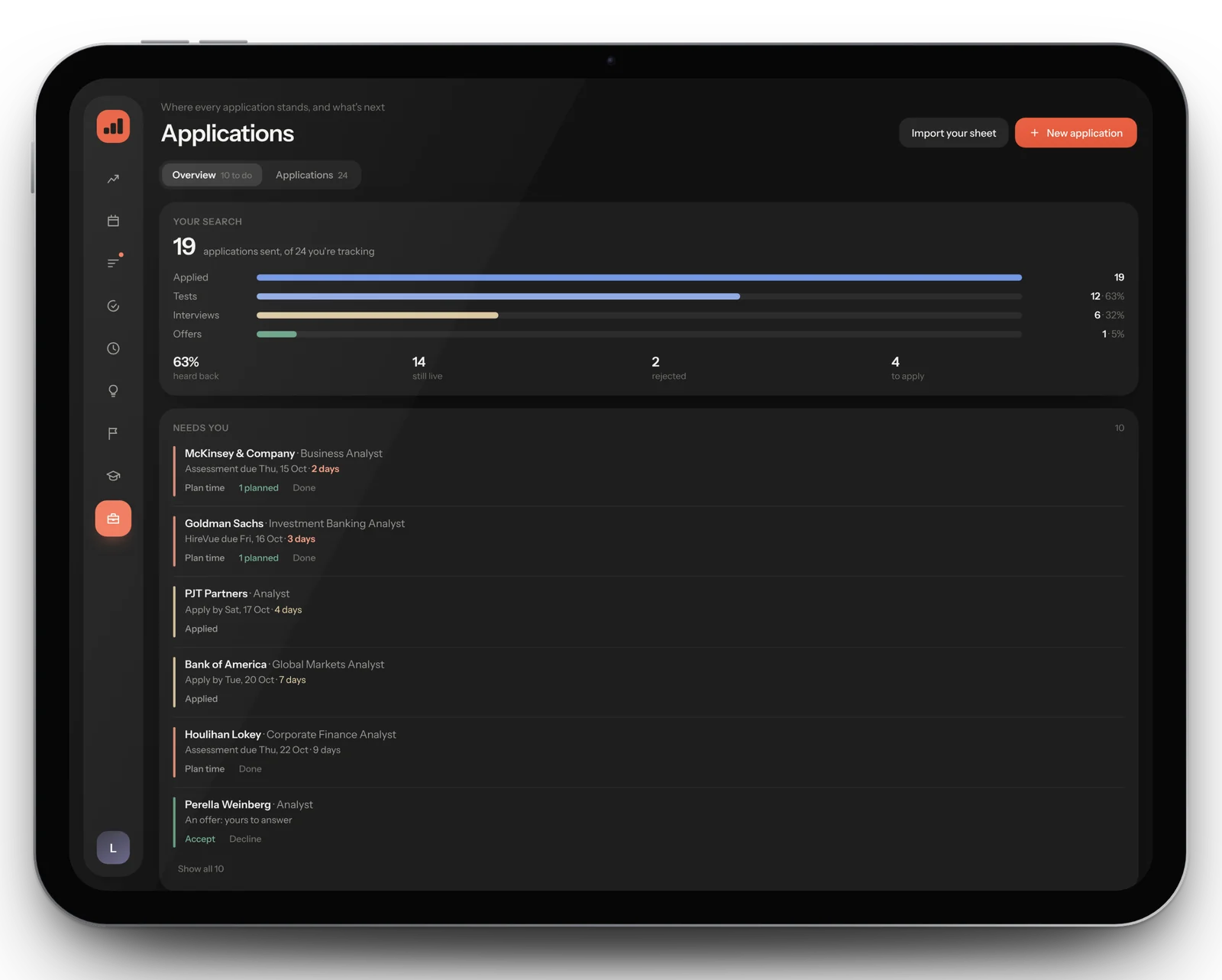
The fix is one row per application, with its stage, the next step and a date for that step, looked at once a week. How to track spring week, internship and grad scheme applications goes through the columns and stages, rolling deadlines, and when to follow up. Ritual's Applications page is built around the same idea.
12How Ritual helps
Ritual's Applications page keeps every spring week, internship and grad scheme in one place, with where each one stands and what needs you next. Bring in the spreadsheet you already use (Excel, CSV or a Google Sheet link) and it reads your own wording for each status. When a test or HireVue arrives, plan time for it on its row and Ritual makes a task linked to that application. Tick the task off and the application moves on by itself, and like any task you finish, it counts towards your day and your share price.
- Closing dates and test deadlines on your calendar as all-day entries
- A "needs you" list: tests and HireVues to do, deadlines in the next two weeks and anything that's been quiet for three weeks
- Your search as a funnel, from applied to tests, interviews and offers
Ritual is in beta. Join the waitlist and you'll hear first when places open.
13Questions, answered
01What year do you do a spring week?
In your first year if you're on a three-year degree, or your second year if you're on a four-year degree. Most spring weeks run around Easter, and applications usually open in August or September, so you apply in the autumn of the same academic year.
02Are spring weeks only for banking?
No. The name comes from investment banking, but law firms, consultancies, accountancy firms, asset managers and tech firms run them too, often under names like insight programme, insight week or first-year insight scheme.
03Are spring weeks paid?
Some are and some aren't. Many unpaid programmes cover travel and accommodation instead. Standard Chartered's 2027 programme, for example, is unpaid but reimburses travel and accommodation for students from outside the London area. Each listing should say what it covers.
04How many spring weeks should I apply to?
There's no right number. Apply to as many as you can do well alongside your degree, starting with the firms and divisions you're most curious about. Generic answers are easy to spot, so a careful application is worth more than several rushed ones, and tracking every application stops a test deadline slipping past.
05Do you need a finance degree for a spring week?
Not usually. Many programmes are open to any degree subject and don't expect industry experience. Standard Chartered's 2027 programme asks for "any degree discipline" with "no prior banking or financial services experience required", and law firms such as Simmons & Simmons take non-law students. Check each listing's eligibility.
06What's the difference between a spring week and an insight day?
An insight day is a single day of talks, workshops and networking. A spring week is longer, usually a few days to two weeks, includes case studies and shadowing, and is more often used by the firm to find future interns.
07Can I do a spring week in second year?
Yes, if you're on a four-year course. On a three-year course most bank spring weeks are for first-years, but some programmes take penultimate-year students, particularly in law, and some are open to students in any year from groups underrepresented in the profession.
08Can I get an internship without a spring week?
Yes. A spring week can help you get noticed early, but you can apply for summer internships and graduate schemes without one, and a well-prepared candidate without a spring week can beat a poorly prepared one who did one.
14Sources
All accessed 27 October 2026. Programme dates and deadlines are for the 2026/27 cycle and change every year.
- TargetJobs, "What is a spring week, insight day or insight programme?" (Abigail Lewis, 2 May 2025)
- Warwick Business School, "Spring week internships: the complete guide"
- Standard Chartered, "Spring Insight Programme 2027 - UK", the firm's listing on TargetJobs (apply by 15 November 2026)
- Simmons & Simmons, "Spring Insight Scheme 2027", the firm's listing on TargetJobs (closes 31 December 2026)
- CMS, "Insight Programme", the firm's listing on TargetJobs (applications open 29 January 2027)
- University of Exeter Business School careers, "Investment Banking Spring Weeks" (PDF, Opening City Doors)
- GOV.UK, "Employment rights and pay for interns"
- Times Higher Education, "Employers cut student work experience roles as demand rises" (14 October 2026), reporting the ISE Student Recruitment Survey 2026
- Wonkhe, "ISE's 2026 student recruitment survey paints a picture of a graduate job market in flux" (13 October 2026)
Something here out of date, or a question the guide doesn't answer? Email hello@getritual.app. More in Guides.